 info@hitchescouplers.com
 Hitches & Couplers,
22895 County Line Rd. Shell Knob, MO 65747
 620-432-6079
 cart


When to Replace Worn Trailer Hitch Balls and Chains
A trailer can feel perfectly stable right up to the moment a worn part gives way.
That is why hitch balls and safety chains deserve more attention than they usually get. A coupler that no longer fits tightly, a ball with visible wear, or chains with damaged hooks can turn a routine trip into a separation event. Federal safety guidance, owner manuals, and common towing practice all point in the same direction: if a towing component shows wear, damage, looseness, or poor fit, replacement is the smart move.
FMCSA guidance under 49 CFR § 393.70(d) focuses on preventing a towed vehicle from breaking loose if the tow-bar fails or disconnects. Private trailer owners may not read that regulation often, yet the safety principle applies just as clearly to gooseneck towing. The connection needs to stay secure, and the backup system needs to work if the primary coupling does not.
Trailer hitch ball wear signs that call for replacement
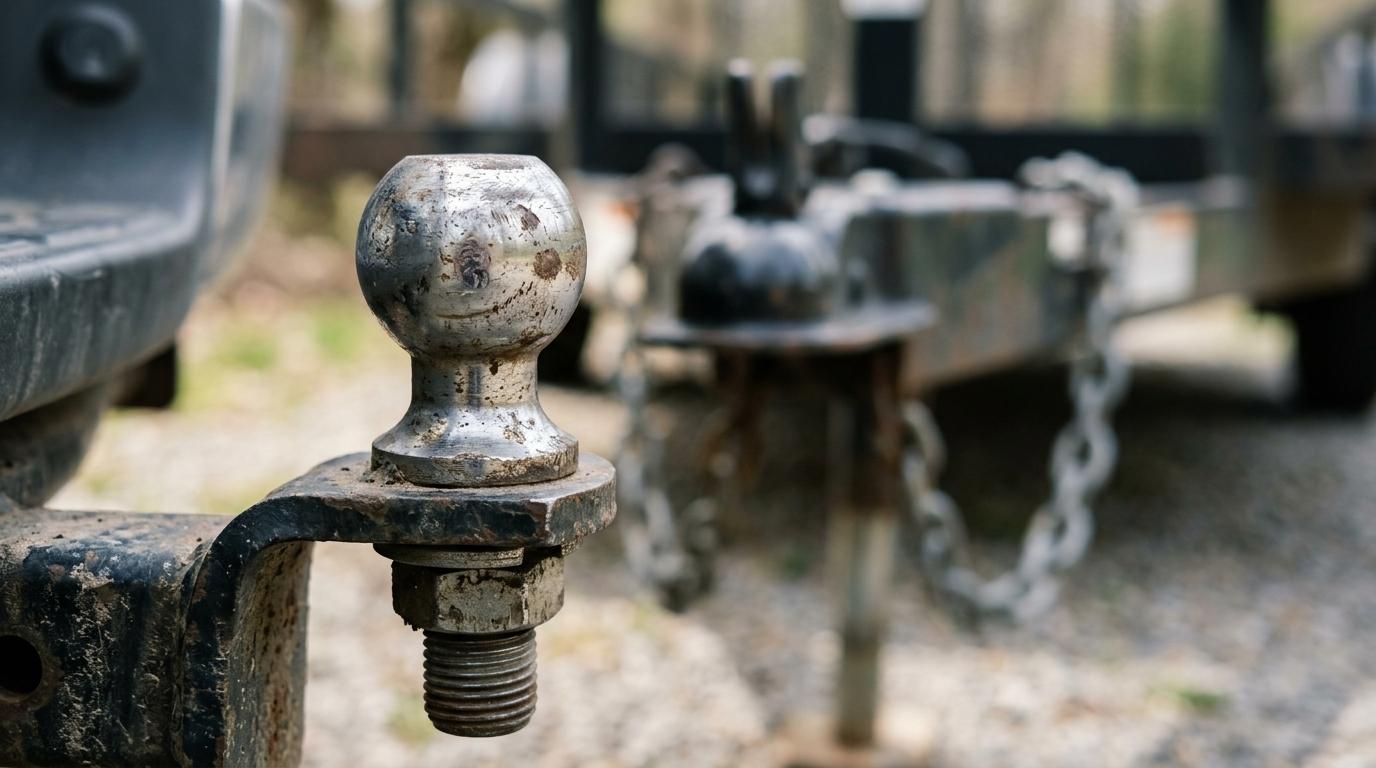
A trailer hitch ball does not need to be visibly shattered to be unsafe. Wear usually shows up slowly. The ball may start to flatten slightly at the top, develop scoring or pitting, or lose its smooth finish from repeated coupling under heavy load. Those changes matter because the coupler depends on precise contact around the ball, not a “close enough” shape.
Size and fit matter just as much as surface condition. A 2 inch coupler on a 2-5/16 inch ball is an obvious mismatch, but many towing problems come from less dramatic issues. A worn ball, a poorly made coupler, or a ball nut that will not stay tight can create slop that feels minor at first and then gets worse under braking, bumps, or sharp turns.
One clue is noise.
If the trailer clunks during takeoff and stopping, if the coupler latch does not close with a confident feel, or if the connection seems loose even when locked, inspect the ball and coupler as a pair. Replacing only one part may not solve the issue if both have worn against each other.
Common hitch ball replacement triggers include:
- flat spots or uneven wear
- deep rust pitting
- scoring and gouges
- damaged threads on the shank
- a ball nut that will not hold proper torque
- visible bending
- repeated looseness after retightening
Safety chain damage and attachment problems to replace now
Safety chains are the backup that should never need to work, but they must be ready to work. FMCSA guidance says the safety device must be connected in a way that prevents separation and keeps the failed tow connection from dropping to the ground. That principle is simple: if the primary connection fails, the trailer still needs to stay with the tow vehicle long enough for the driver to stop in control.
A chain can look “good enough” and still be past its safe life. Link wear, stretching, rust scale, bent hooks, damaged latches, or worn attachment points all reduce the margin that chains are supposed to provide. The same is true for chain mounts on the trailer or hitch frame. Strong chains attached to weak anchor points do not solve the problem.
NHTSA has reported that road debris and unsecured loads are involved in hundreds of deaths and many thousands of injuries each year. A separated trailer or dragging drawbar is not just a problem for the tow vehicle. It can become everyone else’s problem within seconds.
Use this quick reference during inspections:
| Component | What to look for | Replace now when | Why it matters |
|---|---|---|---|
| Hitch ball | Smooth round surface, secure shank, correct size | Flat spots, pitting, bent shank, damaged threads, recurring looseness | Poor fit can let the coupler move or disengage |
| Coupler latch | Full lock engagement, no excessive play | Latch will not stay locked, visible cracking, loose internal parts | The ball cannot stay secure if the latch cannot hold it |
| Safety chains | Even links, no stretching, sound welds | Elongated links, heavy corrosion, cracked welds, bent hooks | Backup connection strength is reduced |
| Chain hooks and latches | Positive attachment, retained connection | Missing safety latches, hook tip spread open, severe wear | Hook can bounce free during a failure event |
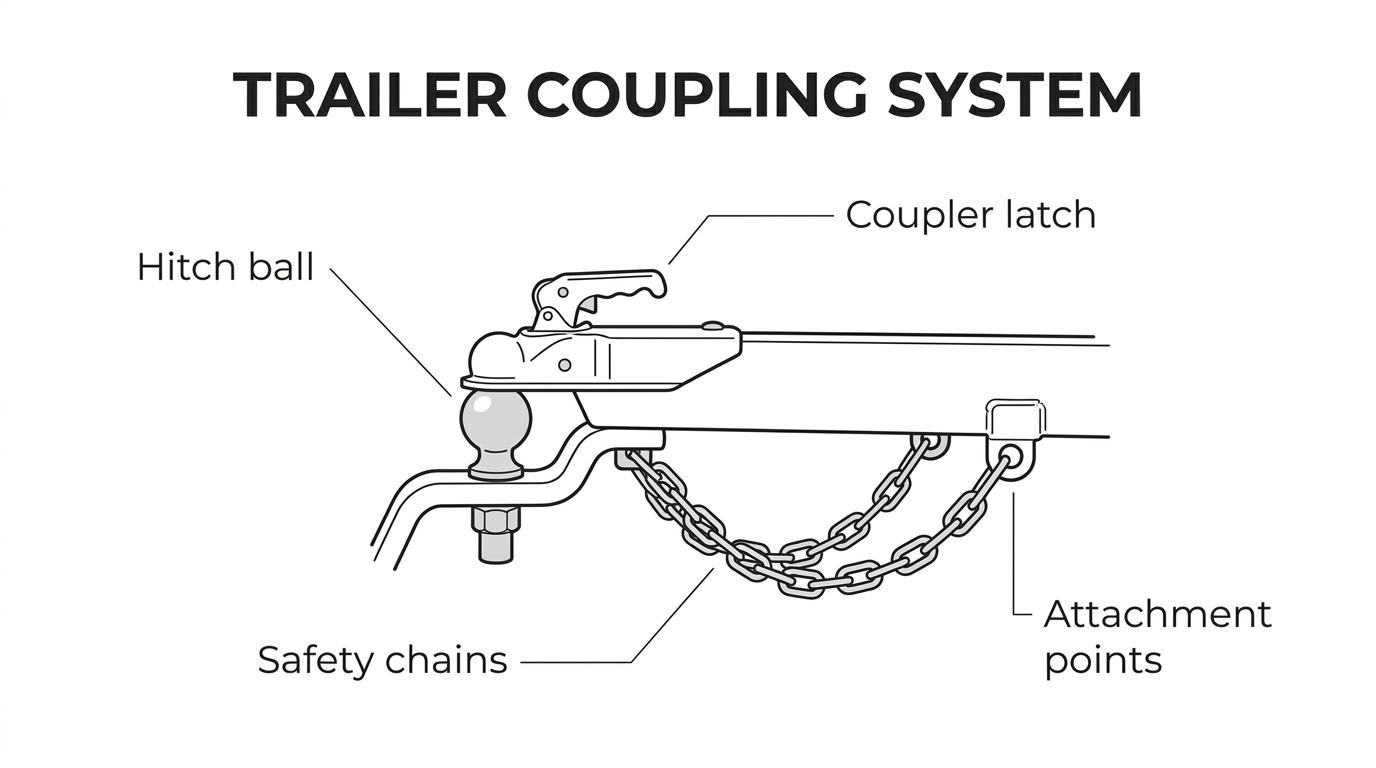
| Attachment points | Solid welded or bolted mounts | Cracks, wallowed holes, bent tabs, rust loss | Chains are only as strong as what holds them |
Trailer coupling fit, ball size, and rating problems that look like wear
Sometimes the part is not worn out. It is simply the wrong part.
A trailer hitch ball must match the coupler size exactly, and its rating must meet or exceed the trailer’s loaded demands. The same rule applies to safety chains, hooks, and chain attachment points. If the system is undersized anywhere, normal towing forces can cause rapid wear that looks like premature failure.
Gooseneck setups deserve close attention here. A gooseneck ball, coupler tube, and safety chain hooks all work in a tighter package than many bumper-pull systems. Some gooseneck hitches include dedicated openings behind the ball for safety chain hooks, which helps keep the hookup more direct and secure. A rotating ball design can also reduce wear in some applications by keeping the socket cleaner and reducing scuffing from a rough coupler.
Poor coupling fit often shows up as repeated symptoms:
- Coupler movement: fore-aft clunking, side play, or visible rocking on the ball
- Latch trouble: hard closing, partial engagement, or a latch that pops up under load
- Chain trouble: chains too long, too short, dragging, or rubbing against sharp edges
- Mounting trouble: chain tabs or hitch hardware showing distortion after towing
If those signs appear together, treat the setup as a system inspection, not a single-part problem.
Pre-trip inspection steps for trailer hitch balls and chains
A solid pre-trip check does not take long, and it catches the problems that usually lead to roadside trouble. Many owners look at the coupler, clip the chains, and move on. A better method is to touch every critical point with intent: the ball, the latch, the chain hooks, the chain mounts, the wiring, and the break-away setup if the trailer uses one.
Do this before every tow, not only before long trips.
A practical routine looks like this:
- Check the hitch ball: Confirm correct ball size, surface condition, and tight mounting.
- Lock the coupler: Close the latch fully and verify it cannot lift off the ball.
- Cross the safety chains: Keep enough slack for turns, but not enough to drag.
- Inspect the hooks and mounts: Make sure the hooks seat fully and the attachment points are sound.
- Test movement: Raise the trailer jack slightly after coupling to confirm the connection holds.
- Verify the backup systems: Check trailer wiring, lights, brakes, and break-away components where equipped.
That last step, raising the jack slightly to test the connection, is one of the most valuable checks in towing. It loads the coupler just enough to reveal a bad latch or incorrect engagement before the trailer is rolling down the road.
Where an electric trailer jack converter fits into safer trailer setup
Inspections are more consistent when hitching is easier.
That is one reason many trailer owners pair hitch maintenance with an electric trailer jack converter upgrade. A powered conversion can make coupling, uncoupling, and test-lifting the trailer much more controlled than manual cranking, especially on heavier trailers or frequent-use rigs.
For owners still using a manual jack, a conversion is often a practical middle ground. Instead of replacing the whole jack system, an electric trailer jack converter can adapt many single speed and 2 speed manual jacks to powered operation. That makes it easier to raise the trailer enough to verify the coupler lock, adjust ball height precisely, and take strain off the hitch during hookup.
This matters even more on dual landing gear setups, where manual lifting can be slow and uneven. A well-matched converter helps reduce setup time while still preserving manual backup operation if power is unavailable. That manual fallback is a real advantage for working trailers that cannot afford downtime.
When owners shop this category, they often look for:
- Fit range: compatibility with single speed and 2 speed manual jacks
- Dual gear support: usable on dual landing gear arrangements where applicable
- Manual backup: operation still possible if battery power is lost
- Made in the USA: a priority for buyers who want current-model domestic equipment
- Warranty coverage: extra confidence for equipment that sees regular service
For businesses and working owners, availability matters too. Hitches & Couplers, Inc. focuses heavily on gooseneck, 5th wheel, trailer jack, and conversion products, including current-model electric trailer jack converter options. Orders placed before noon CST can ship the same business day, and shipping to the lower 48 states is free. That can make a real difference when a worn hitch component and a stubborn manual jack are both slowing down the next load.
Replacement timing and downtime planning for towing equipment
Waiting for total failure is the most expensive replacement strategy.
A worn hitch ball or chain usually sends warnings first: visible wear, repeated noise, poor latch feel, rust scale, hook distortion, or a hitch connection that no longer inspires confidence. Replacing early costs less than dealing with trailer damage, lost time, or a roadside incident. It also gives you room to choose the right part instead of whatever is available locally at the last minute.
When replacing a hitch ball, confirm shank diameter, shank length, ball size, and rating. For gooseneck applications, check whether a standard replacement ball, a 3 inch ball, a heat-treated stainless option, or a hi-rise or offset style is the correct match for the hitch and trailer combination. For chains, match working load expectations, hook style, and the actual attachment points on the truck and trailer.
Many owners use replacement day to tighten up the whole towing routine. That can mean a fresh ball, new safety chains or hooks, cleaner chain routing, and a move to an electric trailer jack converter if manual lifting has become slow or inconsistent. The result is not only easier hookup. It is a more reliable inspection process every time the trailer is connected.
If the trailer is used for work, livestock, equipment hauling, or regular RV travel, that kind of reliability pays back quickly. A hitch system should feel secure before the truck ever leaves the driveway, yard, or jobsite.
Keywords:
trailer hitch ball