 info@hitchescouplers.com
 Hitches & Couplers,
22895 County Line Rd. Shell Knob, MO 65747
 620-432-6079
 cart


What Affects Trailer Jack Speed and Lifting Power Most
A trailer jack can feel either impressively quick or impressively strong, but rarely both at the same time. That is not poor design. It is basic mechanics.
When people ask what affects trailer jack speed and lifting power most, the answer usually comes down to a small group of factors: gear ratio, screw pitch, friction, hydraulic flow, hydraulic pressure, stroke length, and rated capacity. If you are also considering an electric trailer jack converter, it helps to know which of those factors the converter changes and which ones remain fixed inside the jack itself.
Trailer jack speed vs lifting power basics
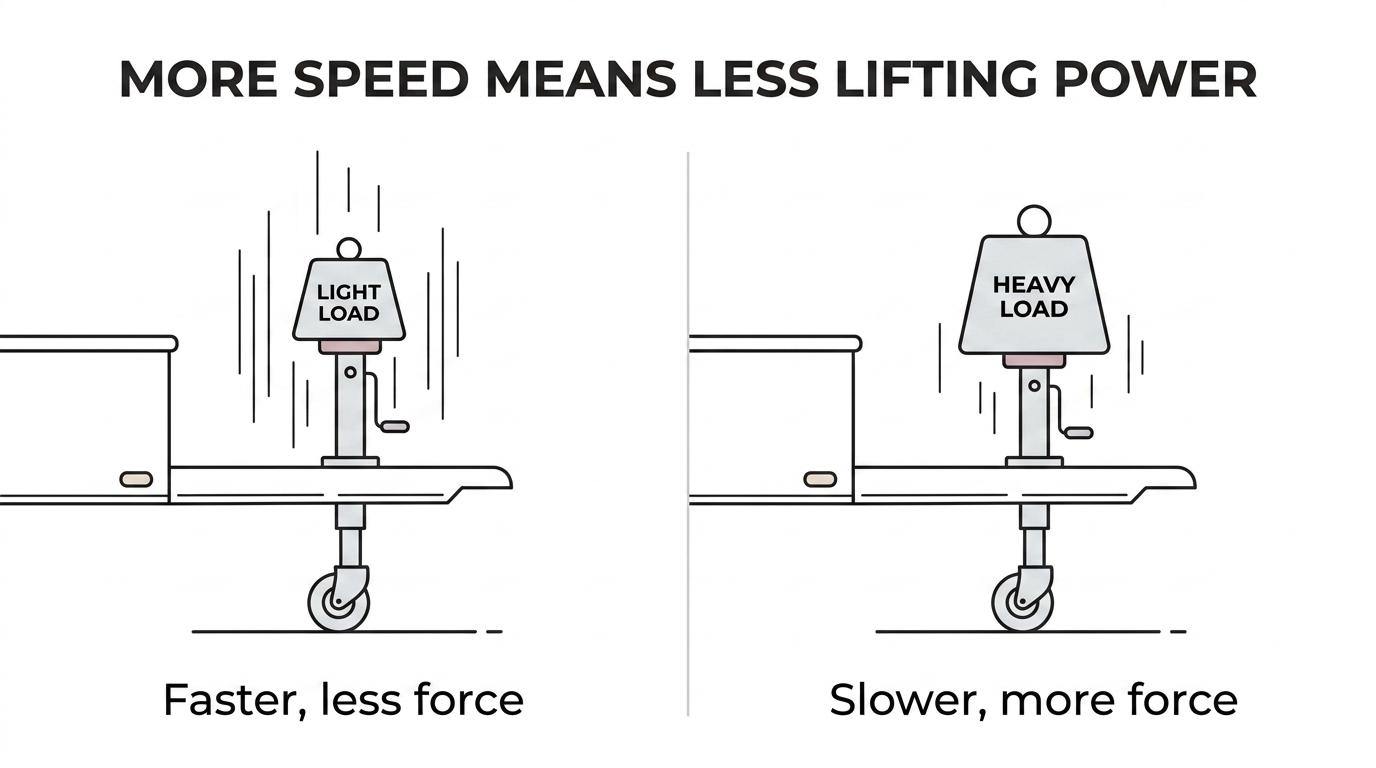
Speed and lifting power are related, but they are not the same thing. A jack that moves fast is not automatically strong, and a jack with high lifting force is often slower by design. With a given power source, there is always a tradeoff between output speed and output torque or force.
That tradeoff shows up in every major trailer jack style. In screw-driven jacks, the tradeoff comes from gear reduction and thread pitch. In hydraulic trailer jacks, it comes from flow rate versus pressure, along with cylinder size. The fastest path to better buying decisions is to separate these variables instead of treating “performance” as one big category.
| Factor | Affects speed most? | Affects lifting power most? | Why it matters |
|---|---|---|---|
| Gear ratio | Yes | Yes | More reduction raises torque but lowers output speed |
| Screw pitch | Yes | Yes | Fine pitch moves less per turn but gives more mechanical advantage |
| Hydraulic flow rate | Yes | No | More flow moves the cylinder faster |
| Hydraulic pressure | No | Yes | Pressure is what creates lifting force in the cylinder |
| Cylinder area | Yes | Yes | Larger area can lift more at a given pressure, but moves slower at a given flow |
| Friction | Yes | Yes | Thread, gear, and seal drag waste energy |
| Stroke length | No | No | It sets travel distance, not force by itself |
| Rated capacity | Indirectly | Indirectly | It defines the load limit the jack is built to handle |
In day-to-day use, these patterns show up in pretty obvious ways:
- Slow but easy cranking
- Fast travel with lighter loads
- Strong lift near the top of the rating, but reduced speed
- Good specs on paper, rough feel in real use because of friction
Screw-driven trailer jack factors: gear ratio, screw pitch, and friction
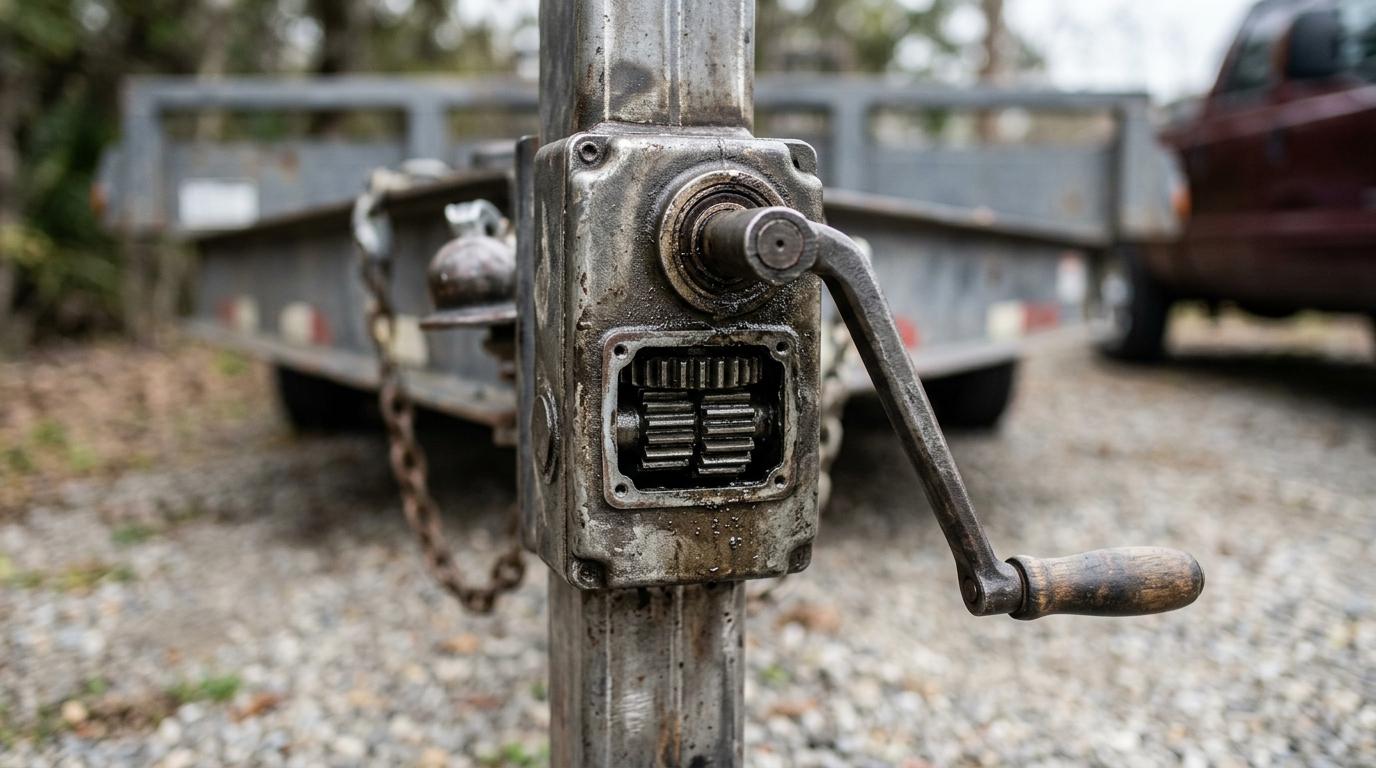
Most manual trailer jacks are screw-driven systems. That means your hand force goes through a crank, into gears, and then into a lifting screw. Each part of that chain affects either speed, force, or both.
Gear ratio is one of the biggest factors. A high reduction ratio multiplies torque, so the jack can lift heavier loads with less effort at the handle or motor. The price is slower movement. Every turn of the input produces less output rotation at the screw. A lower reduction ratio does the opposite. It can move the jack faster, but it asks more from the person cranking or the motor driving it.
Screw pitch matters just as much. A fine-pitch screw advances a shorter distance per turn. That makes it slower, yet stronger, because it creates more mechanical advantage. A coarse-pitch screw travels farther per turn, which feels faster, but it needs more input torque for the same load. This is why two jacks with similar outside dimensions can behave very differently under the same trailer.
Friction is the factor many owners overlook. Screw threads, bearings, gears, and bushings all consume energy. Some friction is built into the design, and some comes from wear, contamination, or lack of lubrication. When friction rises, speed drops and usable lifting force drops with it. A jack that once felt smooth can become stubborn long before it is fully worn out.
That is also why an electric conversion can feel transformative even when the jack’s internal mechanics stay the same. The motor does not change the screw pitch, but it can deliver more consistent input than a tired arm on a cold morning.
Hydraulic trailer jack factors: flow rate, pressure, and cylinder area
Hydraulic trailer jacks separate speed and force more clearly than screw-driven jacks do. In a hydraulic system, flow rate mainly determines how fast the cylinder extends or retracts. Pressure mainly determines how much force the cylinder can produce against the load.
There is a simple way to think about it. More hydraulic flow means faster cylinder movement. More hydraulic pressure means more lifting force, within the limits of the system. Cylinder area ties those together. A larger piston area can create more force at the same pressure, but it also needs more fluid volume to move at the same speed. So a large cylinder can be very capable, yet slower if the pump flow stays the same.
A real product example makes this easier to picture. A hydraulic gooseneck trailer jack may use a 24-inch stroke cylinder, lift up to 12,000 pounds on a single leg or 24,000 pounds on a dual-leg setup, and move at up to 30 inches per minute. Those numbers describe three different traits: how far it can travel, how much it can lift, and how fast it can move. They are connected, but they are not interchangeable.
That is why two hydraulic jacks with the same lift rating can still move at noticeably different speeds.
Stroke length and load capacity in trailer jack performance
Stroke length does not create lifting power by itself. It tells you how far the jack can extend in one full cycle. A longer stroke can be very convenient on taller trailers or uneven ground because it reduces the need for blocks or repeated repositioning. Yet if two jacks move at the same inches per minute, the longer-stroke jack will simply take longer to run from fully retracted to fully extended.
Rated capacity is just as easy to misuse. A 12,000-pound-rated jack is not a promise that every lift will be equally fast and effortless up to 12,000 pounds. It means the jack is built to safely handle loads up to that limit under the intended conditions. As load increases, real-world speed often tapers off, motor draw rises, and mechanical stress goes up.
A good spec sheet usually tells you three different things, not one:
- Stroke length: how far the jack can travel
- Rated capacity: how much load it can safely lift
- Operating speed: how quickly it moves under stated conditions
- Real load share: how much of the trailer weight the jack is actually carrying at hitch height
How an electric trailer jack converter changes real-world trailer jack use
If you already own a sound manual gooseneck jack, converting it to electric can be a very smart move. The big gain is not magic lifting power. The big gain is replacing repetitive hand cranking with steady motor-driven input.
That matters because people are inconsistent power sources. A motor is not. Manual cranking speed varies with fatigue, weather, trailer weight, and awkward body position. An electric trailer jack converter delivers repeatable torque and repeatable rotation rate. The result is often faster everyday operation, even when the jack’s internal gear ratio and screw pitch stay exactly the same.
This is the key point many buyers miss: a converter changes the input side of the system, not the internal physics of the jack. If the jack uses a slow, high-torque screw and reduction set, it will still be a slow, high-torque jack after conversion. What changes is how easy it is to use that built-in capability.
That is why purpose-built conversion kits are so appealing for working trailers. A well-matched electric trailer jack converter can bring power operation to existing single-speed and 2-speed manual jacks without forcing a complete jack replacement.
After that basic mechanical point, fitment and use case become the next filter:
- Single-speed manual jacks: a strong choice when the goal is to eliminate hand cranking on a proven jack
- 2-speed manual jacks: useful when the jack already offers speed and torque ranges and you want motorized operation
- Dual landing gear setups: valuable when repeated lifting and lowering happens across paired legs
- Manual backup operation: important when battery power is unavailable and uptime still matters
Choosing an electric trailer jack converter for your trailer jack setup
The best converter choice starts with your current jack, not with a generic motor rating. Shaft style, jack design, trailer weight, and how often you use the trailer all matter. A horse trailer used every weekend has different demands than a flatbed used a few times each month.
A practical buying checklist helps narrow things quickly:
- Check whether your manual jack is single-speed or 2-speed.
- Verify compatibility with your jack’s drive arrangement.
- Think about whether you are operating a single jack or dual landing gear.
- Confirm there is a manual backup option.
- Match the converter to the load you actually put on the jack, not just the trailer’s gross rating.
This is where a specialized product line stands out. A converter designed specifically for gooseneck trailer jacks is usually a better path than trying to adapt a generic motor. Product fit, mount geometry, and backup operation matter just as much as raw power.
Electric trailer jack converter ordering details: shipping, warranty, and product origin
Availability and support matter almost as much as the specs. If a trailer is down during hay season, sale season, or a planned trip, shipping speed is part of the value. Current-model electric conversion products from a specialized towing supplier can help cut guesswork, especially when the catalog is focused on gooseneck and 5th wheel towing equipment rather than general accessories.
For buyers comparing sources, a few details are worth checking before placing the order:
- Free shipping to the lower 48 states
- Same-business-day shipping before noon CST
- Ships across the U.S. and to Canada
- Warranty coverage
- Made in the USA options where listed
Those details are especially relevant when you are buying an electric trailer jack converter for a working trailer and want a faster path from order to installation. A specialized dealer that focuses on towing and landing gear products can also make it easier to match the converter to a single-speed jack, a 2-speed manual jack, or a dual landing gear setup without trial and error.
The mechanics never change: speed is usually limited more by flow, gear ratio, or screw pitch, while lifting power is usually limited more by pressure, torque, and mechanical advantage. What changes with the right converter is how easily you can put that built-in capability to work every time you hitch, unhitch, level, or service the trailer.
Keywords:
trailer jack