 info@hitchescouplers.com
 Hitches & Couplers,
22895 County Line Rd. Shell Knob, MO 65747
 620-432-6079
 cart


How to Measure for the Right Gooseneck Coupler Size
A gooseneck coupler looks simple until it is time to replace one. Then the details matter fast.
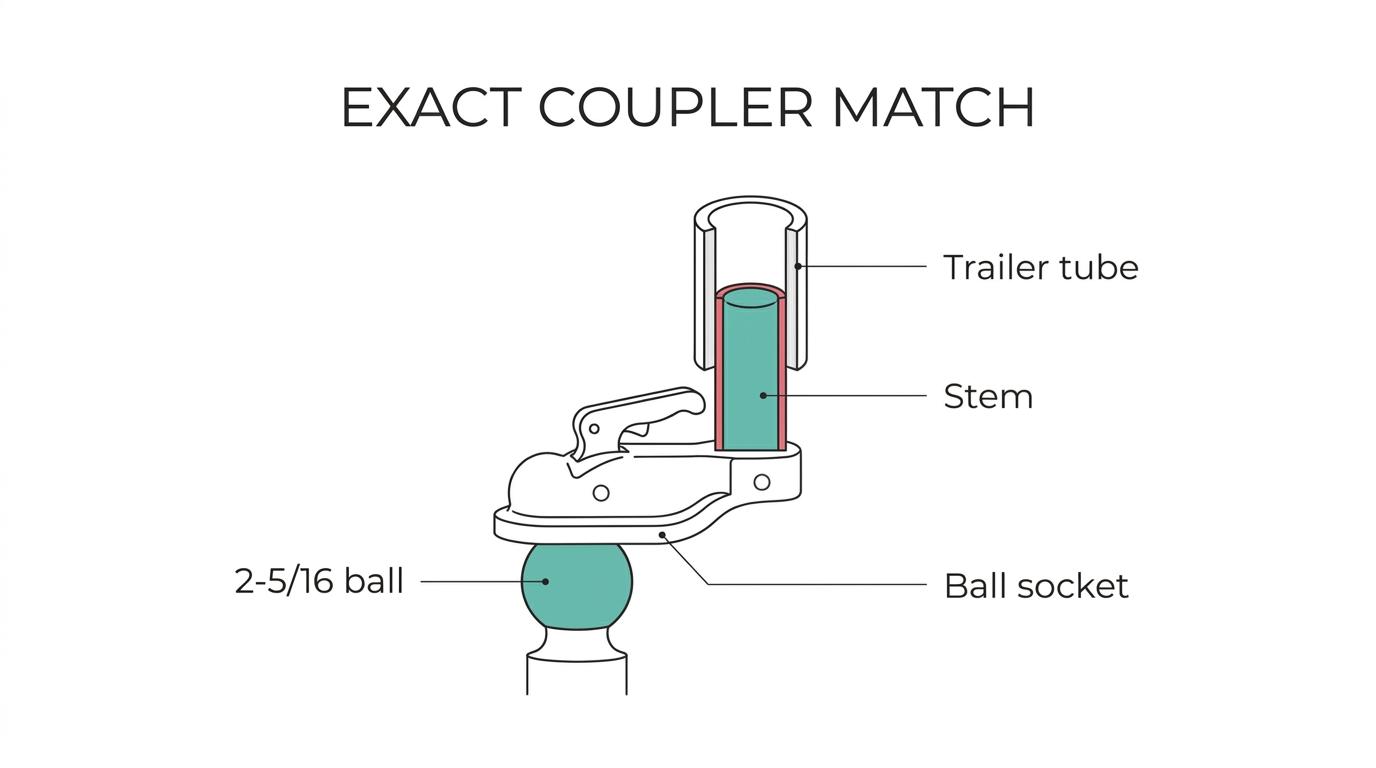
The right fit depends on two matches happening at the same time: the ball socket has to match the hitch ball, and the coupler stem has to match the trailer hardware already welded into the neck. If either side is off, the result can be excess play, poor adjustment, a difficult hookup, or a coupler that will not install at all.
Why gooseneck coupler size starts with the ball
Most gooseneck trailers in this segment use a 2-5/16 inch diameter gooseneck ball. That is the standard size repeatedly shown across manufacturer listings and installation sheets, and it is the first detail to verify before taking any other measurement.
This step sounds obvious, yet it is where many ordering mistakes begin. Owners may focus on trailer stem size and forget to confirm the socket size stamped on the coupler or the ball size on the truck. A coupler designed for a 2-5/16 inch ball needs that exact match. One manufacturer instruction sheet states plainly that the coupler will only work with a 2-5/16 inch gooseneck ball.
That precision matters for safety, not just fit. Federal guidance stresses that a trailer must be coupled to the frame, or a frame extension, with safety devices that prevent separation if a component disconnects. There have also been recall actions involving adjustable ball couplers with excessive play on a 2-5/16 inch ball, with the warning that uncoupling could occur in severe conditions.
What to measure on an existing gooseneck coupler
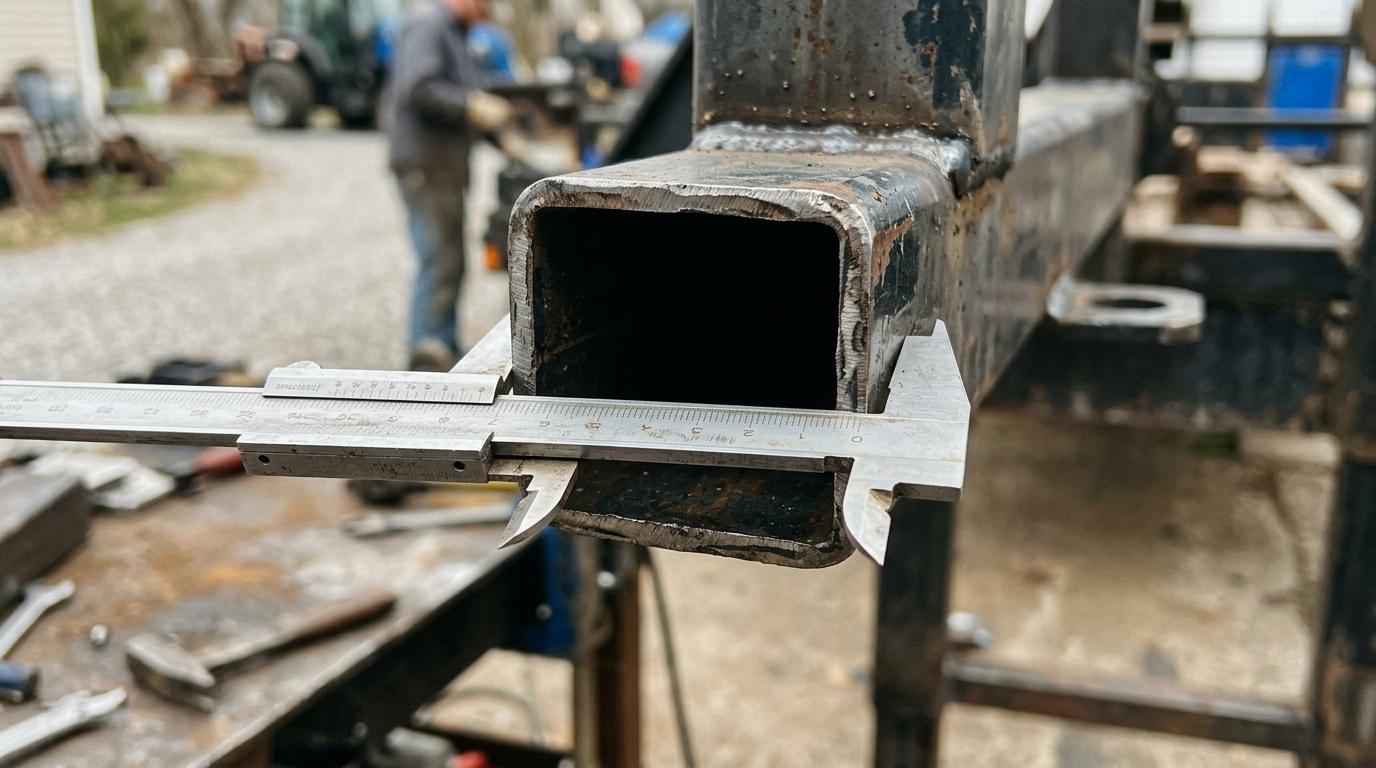
Before removing anything, take photos from several angles. Then measure the current coupler and the receiving tube on the trailer. A tape measure can handle many of the basics, though calipers help when wear or paint buildup makes the fit less obvious.
The goal is to identify the actual stem format, not the one you think should be there. Popup-style replacement couplers are commonly offered with a 4 inch round trailer stem, a 4 inch square trailer stem, or a 4-1/2 inch square trailer stem. Those sizes are close enough to confuse people from memory and different enough to stop a project cold.
Capture these measurements before you order:
- Ball socket size
- Stem shape
- Stem outside dimension
- Tube inside dimension
- Pin hole diameter
- Pin hole spacing
- Current adjustment range
- Bed rail clearance when hitched
Gooseneck coupler stem sizes and shapes to match
Once the ball size is confirmed, the stem is the next checkpoint. This is the vertical section that slides into the trailer’s outer tube and locks in place with pins. The stem must match the trailer’s receiving structure by shape and size.
A round stem does not substitute for a square tube. A 4 inch square stem will not fit a 4-1/2 inch square opening correctly. Even if it drops in, that does not mean it is right. Slop in the stem can create movement, wear, and trouble keeping the trailer at the same ride height.
| Coupler stem format | Typical replacement style | What to measure | Common note |
|---|---|---|---|
| 4 inch round trailer stem | Round self-latching coupler | Outside diameter of stem and inside diameter of outer tube | Often seen on older or specific neck designs |
| 4 inch square trailer stem | Square self-latching coupler | Flat-face width of stem and tube opening | A very common replacement size |
| 4-1/2 inch square trailer stem | Larger square self-latching coupler | Flat-face width across the stem and tube | Used where the trailer neck was built for a heavier or different outer tube |
Popup Hitch identifies these formats clearly in its coupler lineup: GN1 for 4 inch round, GN2 for 4-1/2 inch square, and GN3 for 4 inch square. That kind of naming helps, though it still does not replace measuring your own trailer.
How to measure the trailer tube for a new gooseneck coupler
Measure the receiving tube, not just the old coupler. Wear on the coupler can hide the true size, and a past owner may have installed a non-original part that is not the best reference.
For a round tube, measure straight across the inside opening if the old stem is removed. If you can only reach the outside, measure the current stem outside diameter and compare it with the tube’s fit. For a square tube, measure across flat sides, not corner to corner. That diagonal number will throw everything off.
If the coupler is still installed, clean the exposed area first. Rust, thick paint, weld spatter, and packed dirt can add enough bulk to distort a reading. Take each measurement twice. If two readings do not agree, stop and check the tool position.
A few practical habits make the process better:
- Use calipers if possible: They reduce guesswork on stem dimensions and pin holes
- Measure the tube opening in more than one place: Wear can make the top looser than the lower section
- Inspect the pin holes closely: Elongated holes can point to long-term movement and may affect fit
- Check for old shims or homemade spacers: These often signal that the existing coupler was never quite right
Gooseneck coupler adjustment range and towing height
A coupler that fits the tube still needs to fit the towing setup. Height adjustment is what lets the trailer run level and keeps truck bed clearance where it belongs.
Some modern couplers offer generous adjustment. One current example lists 8 inches of adjustment, which gives helpful room when the same trailer may be pulled by more than one truck. That adjustability also matters if you move between pickup beds, flat-bed trucks, or trucks with different tire and suspension heights.
The pin and bolt arrangement can matter here too. One installation sheet notes that a longer carriage bolt is used for lower gooseneck balls, while a shorter bolt is used for taller gooseneck balls. That kind of detail is easy to miss when people focus only on the tube size.
When you set height, keep these checkpoints in mind:
- Trailer attitude: level or slightly nose-down within the trailer maker’s guidance
- Bed rail clearance: enough space above the truck bed during turns and uneven ground
- Pin engagement: full, clean fit through the coupler holes
- Ball seat contact: the socket should sit properly on the ball without unwanted play
When an extended or offset gooseneck coupler makes sense
Sometimes the issue is not basic size. It is geometry.
An extended or offset gooseneck coupler can help if the trailer needs more room between the front of the trailer and the truck, or if the body style of the tow vehicle changes where the trailer sits. Popup-style offset couplers are available in several lengths, including 6 inch, 9 inch, 12 inch, and 16 inch offsets.
That can be useful with flat-bed trucks, where the relation between the hitch point and the deck is different from a standard pickup box. Some models are built with longer stems below the offset section for that application. There are also heavy-duty versions intended for trailers with heavier nose weights, including wedge car trailers and similar designs.
An offset coupler is not a shortcut for poor sizing. The stem still has to match the trailer tube, and the ball still has to be the correct 2-5/16 inch size.
Coupling procedure and safety devices still matter after sizing
The gooseneck coupler can be the correct size and still be used incorrectly. Proper coupling procedure matters every time the trailer is hooked up.
One manufacturer’s instructions call for lowering the coupler onto the gooseneck ball before inserting the clevis pins and lynch pins. That order matters because it helps the parts settle into their working position before the retaining hardware is locked in place. Couplers with self-latching features may speed hookup, yet they still need inspection before rolling.
Safety devices matter just as much as the coupler body itself. Federal guidance is clear that the arrangement should prevent the vehicles from separating if the drawbar fails or disconnects. On a gooseneck trailer, that means the whole connection system deserves attention, not just the coupler socket.
A related upgrade worth considering: electric trailer jack converter
Many owners replace or remeasure a gooseneck coupler while the trailer is already in the shop. That is also a smart moment to look at the front-end lifting setup. If crank effort is slowing hitching, an electric trailer jack converter can turn a manual gooseneck jack into a push-button setup without giving up backup operation.
That matters because accurate coupler height adjustment is easier when the jack is easy to use. Fine-tuning the trailer nose over the ball becomes quicker, especially on heavy trailers or when hitching alone.
For buyers comparing options in this product category, the strongest features usually include:
- Fit range: works with many single speed and 2 speed manual jacks
- Dual setups: available for dual landing gear arrangements
- Manual backup: allows operation if electrical power is unavailable
- Shipping terms: same-business-day shipping before noon CST and free shipping in the lower 48 states
- Product support: warranty coverage and Made in the USA options where listed
Hitches & Couplers, Inc. gives this category a strong place in its catalog, which makes sense for trailer owners who want a practical upgrade at the same time they are sorting out coupler fit. A coupler swap fixes the connection point. An electric trailer jack converter changes the daily experience of hitching and unhitching.
What to have ready before ordering a replacement gooseneck coupler
Ordering gets easier when all the data is in front of you. A few numbers and photos can prevent the usual back-and-forth.
Start with the ball size, then the stem format, then the adjustment needs. If the trailer has unusual front-end clearance issues, flat-bed use, or a heavy nose, note that too. Those details can point you toward a standard coupler, an offset design, or a heavier-duty option.
A good order file usually includes:
- A photo of the full trailer neck
- A close photo of the existing coupler
- A measurement of the stem shape and size
- A measurement of the receiving tube
- A note confirming 2-5/16 inch ball compatibility
- A note on current truck type and bed style
That short prep work is usually the difference between a smooth install and an avoidable return. When the socket matches the ball and the stem matches the trailer hardware, the gooseneck coupler is doing exactly what it should: connecting solidly, adjusting correctly, and helping the trailer tow with confidence.
Keywords:
gooseneck coupler