 info@hitchescouplers.com
 Hitches & Couplers,
22895 County Line Rd. Shell Knob, MO 65747
 620-432-6079
 cart


How to Find Your Trailer Pin Box Model Before Ordering
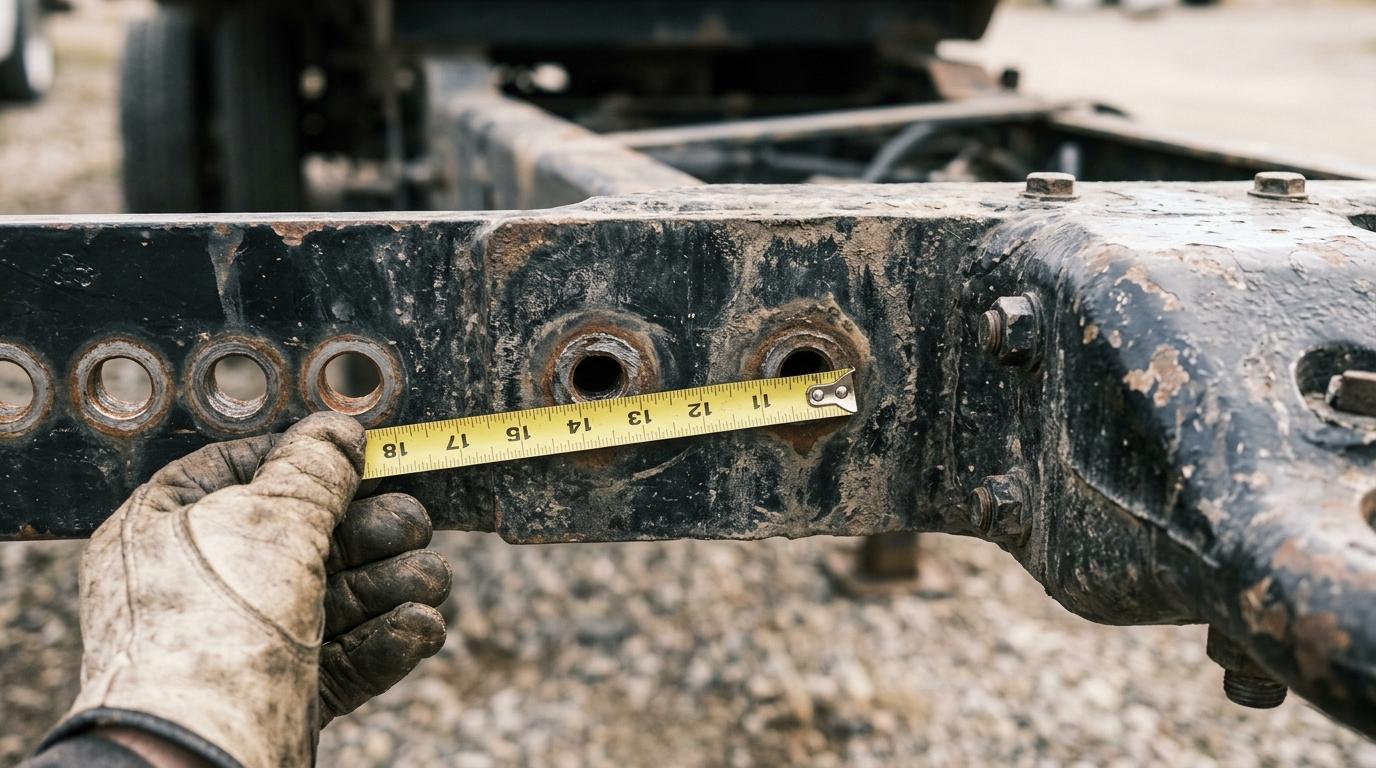
Ordering a replacement king pin box can look straightforward right up to the moment the fit chart asks for a model number you cannot find. Many trailers carry a box that has been on the unit for years, covered in road grime, paint, or surface rust. At that point, guessing gets expensive.
The safest way to order is to identify the existing pin box first, then verify it with measurements. That matters whether you are replacing a worn box, changing ride characteristics, or shopping for a 5th wheel to gooseneck adapter or a fifth wheel to gooseneck adapter.
Why king pin box model identification matters
A king pin box is not a universal part. Two trailers from the same brand can use different pin box models, and two boxes that look nearly identical from the ground can have different mounting wings, bolt spacing, and kingpin location. Ordering by trailer brand alone is not enough.
This becomes even more important when you are looking at conversion products. A replacement box that connects a fifth-wheel trailer to a gooseneck ball must match the original pin box family, not just the trailer’s make or floorplan. Some conversion products fit multiple legacy models, which is helpful, but only after the original fit group has been confirmed.
That is why the fastest first check is always the existing box itself. If the label is gone, the backup method is measurement. Both steps matter.
Where to find king pin box model markings
Start with the pin box frame. On many trailers, the best clue is a label, stamp, or mounted tag on the box itself. Some manufacturers and component guides also point owners to a white sticker with a four-digit number, often a code like 1716 or 1621. If you see a number in that format, write it down exactly as shown, including any prefixes or suffixes.
If the pin box has been repainted or weathered, the information may still be nearby on the trailer. Serial numbers may be stamped into the pin box frame, attached to a tag on the pin box frame, stamped in the entrance door frame, or placed on a steel crossmember in the lower front compartment. Your title, insurance documents, bill of sale, or owner registration card can help verify trailer identity, though those records do not replace the need to identify the actual box model.
| Check area | What to look for | Why it helps |
|---|---|---|
| Pin box frame | Sticker, stamp, or metal tag | Fastest route to the actual model family |
| White label on the box | Four-digit code | Common way some pin box models are identified |
| Mounting wing area | Shape and hole layout | Useful when comparing against fit charts |
| Front compartment crossmember | Stamped serial information | Helps confirm trailer identity |
| Entrance door frame | VIN or serial stamp | Good backup reference |
| Owner documents | Title, insurance, registration | Helps cross-check the trailer, not the box fit by itself |
A few minutes spent cleaning the front of the trailer can save hours of ordering confusion. Wipe dirt from both sides of the mounting wings, inspect the underside with a bright light, and take close photos before you begin measuring.
Measurements to identify a king pin box without a label
When markings are missing, measurement becomes the deciding step. This is where a tape measure, straight edge, and clear photos matter more than guesswork. The key is to measure from consistent reference points, usually bolt-hole centers and the center of the kingpin.
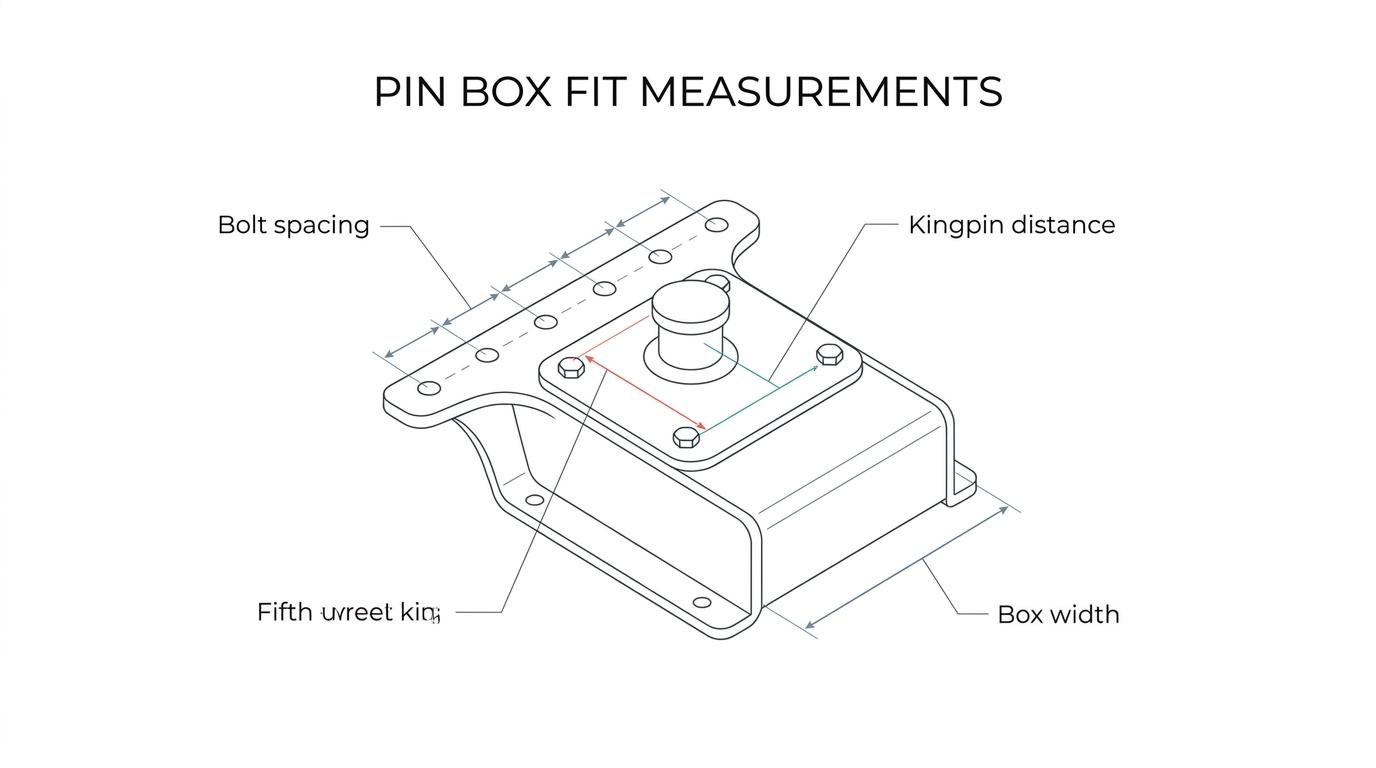
Most fit guides rely on a combination of wing style, box length, bolt pattern, box width, and the distance from the kingpin to the front row of bolts. That kingpin-to-bolt distance is often what separates one family from another.
Before measuring, park on level ground, chock the trailer securely, and work in good light. Dirt around bolt heads and wing edges can make the pattern look different than it really is, so clean those areas first.
Take these measurements and notes before you order:
- Horizontal bolt spacing: center-to-center distance across the bolt pattern
- Vertical bolt spacing: center-to-center distance between bolt rows
- Kingpin-to-bolt distance: from the kingpin center to the front row of mounting bolts
- Box width: outside width of the main box section
- Mounting wing shape: straight, tapered, elongated, or another visible profile
- Overall photos
- Left and right side photos
- GVWR from the trailer data label
A measurement set like this gives a supplier enough detail to separate look-alike options. It also helps when the same replacement part fits several original models. One product may cover a group of Lippert, Fabex, or RBW models, but only if the original geometry matches that fit family.
Ordering a fifth wheel to gooseneck adapter by confirmed pin box model
If your goal is a conversion, model confirmation becomes even more valuable. A 5th wheel to gooseneck adapter that replaces the original king pin box has to place the coupler in the right position and match the original mounting pattern. This is not a place for rough visual comparison.
A good example is a replacement 5th-wheel kingpin box for a gooseneck hitch that fits several model families, including Lippert 1716, 1116, and 0115, multiple Fabex models, and RBW 7028. That kind of overlap is helpful, yet it also proves the point: the exact original box model still matters before ordering. A fifth wheel to gooseneck adapter may serve multiple fit groups, but not every fit group.
This is why trailer owners should resist ordering by trailer brand, body style, or online photo match. The right conversion part is chosen by the existing king pin box model or by verified dimensions when the label is gone.
A quick comparison table can make the process easier:
| Ordering method | Reliability | Best use |
|---|---|---|
| Trailer brand only | Low | Starting point only |
| Visual similarity | Low | Helpful for narrowing options, not final selection |
| Pin box label or stamp | High | Best first check |
| Measured bolt pattern and kingpin location | High | Best backup when label is missing |
| VIN or owner paperwork only | Moderate | Confirms trailer identity, not box fit by itself |
Why the Electric Trailer Jack Converter belongs in the same upgrade plan
Once owners start working at the front of the trailer, they often notice another weak point in day-to-day towing: manual lifting effort. This is where the Electric Trailer Jack Converter is especially valuable.
The Electric Trailer Jack Converter is especially valuable for owners who also run gooseneck trailers with manual jacks. It turns a repetitive crank task into powered operation, which saves time at hookup, unhitching, and trailer leveling. If your towing setup includes a fifth-wheel RV on some trips and a gooseneck equipment or stock trailer on others, that kind of upgrade changes the daily routine in a very practical way.
There is also a planning advantage. People who are already confirming front-end dimensions, coupler height, and truck-bed clearance are in the right frame of mind to upgrade jack operation at the same time. That does not mean a pin box replacement and an Electric Trailer Jack Converter are the same product. They are not. It means they often belong in the same decision window because both affect the front-end workflow and overall towing convenience.
The owners who get the most value from an Electric Trailer Jack Converter tend to care about the same things that matter in a pin box order: correct fit, dependable operation, and less strain every time the trailer moves.
That benefit shows up in everyday use:
- Faster coupling and uncoupling
- Less physical effort
- Better control during height adjustment
- A cleaner routine at the jobsite or campground
Electric Trailer Jack Converter benefits for towing owners
When a trailer setup gets more capable, the support equipment should keep pace. A well-matched king pin box or a properly selected 5th wheel to gooseneck adapter improves how the trailer connects to the truck. An Electric Trailer Jack Converter improves what happens right before and right after that connection.
Think about the small delays that add up over a season: cranking a loaded front end, adjusting height in short increments, or repositioning after a near miss on coupler alignment. Powered jack conversion reduces that friction. For owners who hitch often, that is not a luxury. It is a smart efficiency move.
Keep these upgrade goals in mind when reviewing your towing setup:
- Speed: less time spent cranking by hand
- Control: finer height changes during hookup
- Consistency: similar routine every time the trailer is used
- Comfort: less fatigue during repeated stops
- Value: a practical upgrade for trailers that see regular service
A practical ordering checklist for king pin box replacement parts
Before you place the order, gather your notes in one place. The cleanest orders happen when the part number, photos, measurements, and trailer data are all ready to share. That gives a supplier a much clearer fit picture and lowers the chance of a return.
If you are ordering a king pin box replacement, a 5th wheel to gooseneck adapter, or a fifth wheel to gooseneck adapter, keep the paperwork simple and exact. Write down the model marking exactly as found, record every measurement in inches, and save photos that show both side wings and the lower box profile.
A strong pre-order file usually includes:
- Model number from the label
- Bolt pattern measurements
- Kingpin-to-bolt distance
- Box width
- Wing profile photos
- Trailer GVWR
- Tow vehicle bed and hitch details if clearance is part of the change
Getting the fit right the first time pays off twice. You avoid the cost of ordering the wrong king pin box, and you build a cleaner path for other upgrades that matter just as much in real use, especially an Electric Trailer Jack Converter that takes the strain out of front-end trailer setup. When towing equipment is chosen with that level of care, the result is not just compatibility. It is a setup that works with confidence every time you hitch.
Keywords:
king pin box