 info@hitchescouplers.com
 Hitches & Couplers,
22895 County Line Rd. Shell Knob, MO 65747
 620-432-6079
 cart


9 Questions Before Buying a 5th Wheel Gooseneck Adapter
Buying a 5th wheel gooseneck adapter looks simple until load math and clearance checks enter the picture. Hitches & Couplers, Inc. sells fifth-wheel and gooseneck towing hardware, so this is a common decision point for owners who want to tow a kingpin trailer from a standard 2-5/16-inch ball in the truck bed.
TL;DR: Summary
- The right 5th wheel gooseneck adapter is the one that matches your trailer’s king pin load weight, your truck’s payload, and your real cab and bed clearance, not just the highest gross rating on the box.
- Ford, GM, and NHTSA all treat king pin load and clearance as core safety checks, with typical fifth-wheel or gooseneck pin weight in the 15% to 25% range of loaded trailer weight.
- GM and NHTSA call for at least 6 inches of pickup-box clearance, and Ford stresses enough cab clearance for turns up to 90 degrees, especially on short-bed trucks.
- Hitches & Couplers, Inc. lists both straight and extended adapter options, including models with 7-1/2 inches of added clearance or a 9-inch offset, but those specs only help if your truck and trailer measurements already support the setup.
- If the adapter purchase changes your whole hookup routine, it is also a good time to review landing gear, manual backup operation, and whether an electric trailer jack converter would make the front-end setup easier.
The safest buying decision is usually less about brand preference and more about fitment discipline. If the adapter, trailer, and truck work together on paper and in measured clearances, the result can be a practical towing setup with an open bed when the trailer is disconnected.
What does a 5th wheel gooseneck adapter actually do?
A 5th wheel gooseneck adapter lets a kingpin trailer connect to a standard 2-5/16-inch gooseneck ball, and Hitches & Couplers, Inc. carries this conversion category because many owners want bed access when they are not towing.
At a basic level, the adapter changes the coupling point from a bed-mounted fifth-wheel hitch to a gooseneck ball. That can be attractive if your truck already has a gooseneck hitch, or if you want to avoid a large fifth-wheel head and rails occupying bed space.
The key point is that this is not just a convenience accessory. It changes hitch geometry, height, turning clearance, and the way vertical load is introduced into the towing system. A common misconception is that any adapter that fits the kingpin is acceptable. In reality, the adapter must match the trailer’s pin load, the truck’s ratings, and the clearances the combination can maintain during turns and uneven approaches.
Is a 5th wheel gooseneck adapter the right choice for your trailer and truck?
Yes, a 5th wheel gooseneck adapter can be the right choice if you already use a gooseneck ball and your trailer, truck, and clearance measurements all support it. A bed-mounted fifth-wheel hitch still makes more sense when factory-style geometry or maximum compatibility matters most.
The main advantage is simplicity. You can tow a fifth-wheel kingpin trailer without installing or leaving a full fifth-wheel hitch in the truck. That matters to owners who use the bed for work, livestock gear, or other cargo between trips.
The trade-off is that adapters are far less forgiving of bad measurements. If your trailer already sits high, your truck is a short bed, or your payload margin is tight, a direct fifth-wheel hitch may still be the better fit. Another item to check early is the trailer manufacturer’s guidance, since some trailers or pin box designs may have restrictions that affect adapter use.
Short-bed owners should be especially cautious. Clearance problems usually show up in slow turns, fuel-station exits, and uneven campground entries long before they show up on a spec sheet.
"Hitches & Couplers, Inc. says its RVCC cushioned adapter adds 7-1/2 inches of cab and tailgate clearance, which is the kind of measured spec short-bed buyers should compare against their own turning needs."
What measurements should you check before buying a 5th wheel gooseneck adapter?
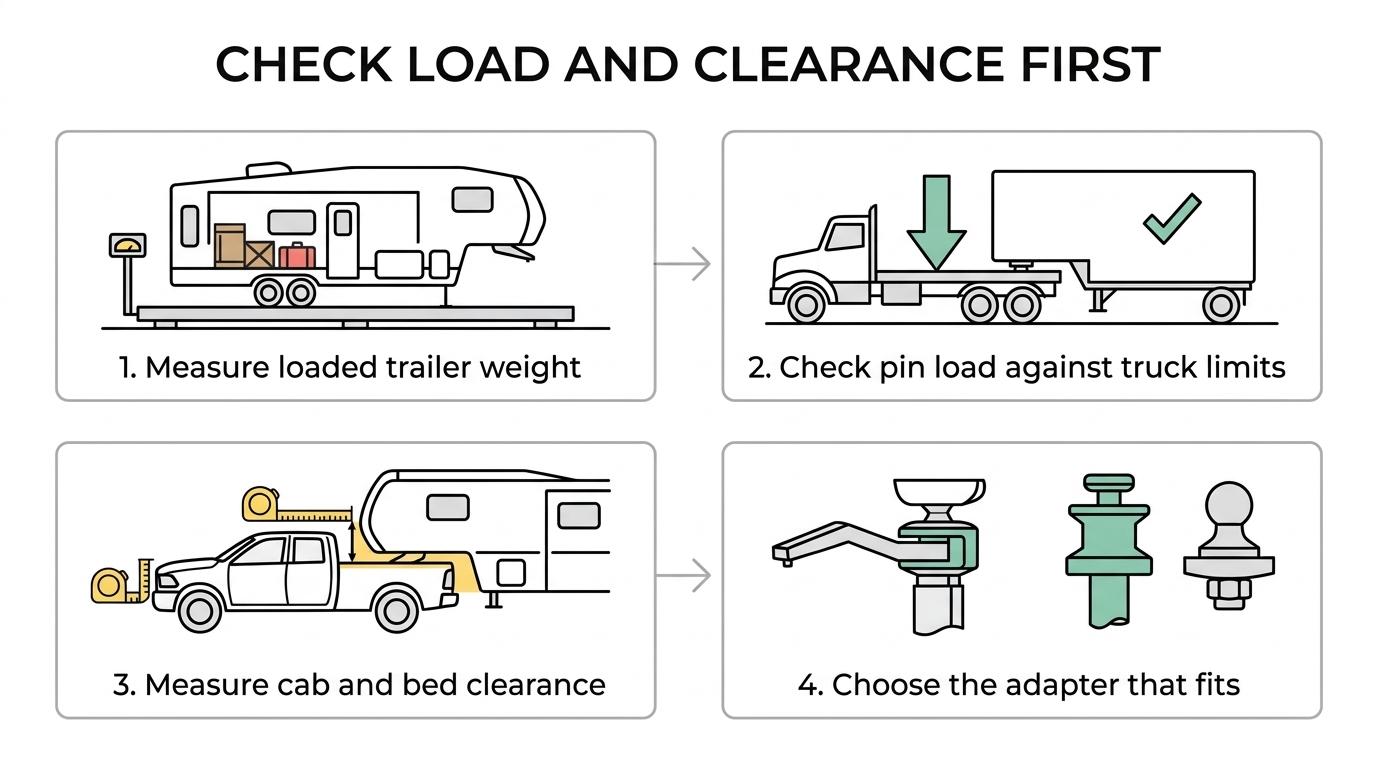
Buyers should measure load, height, and clearance before they compare models. Ford, GM, and NHTSA all treat king pin load weight, rear-axle placement, and cab or pickup-box clearance as primary safety checks.
Start with actual towing geometry, not assumptions based on truck class or trailer length. Two trailers with the same gross weight can have very different nose shapes, overhang heights, and kingpin loads.
- Loaded trailer weight: Use the real travel-ready number, not a dry brochure figure.
- Expected king pin load weight: Plan around roughly 15% to 25% of loaded trailer weight, depending on the truck maker guidance you are using.
- Truck payload and rear axle capacity: The truck must carry king pin load plus passengers, fuel, tools, and bed cargo.
- Cab-to-trailer clearance: You need enough room for sharp turns, especially with a short-bed pickup.
- Pickup-box clearance: GM and NHTSA call for at least 6 inches between the top of the bed and the trailer overhang.
- Adapter height and ball interface: Confirm the required height range and that the setup is designed for a 2-5/16-inch ball.
How do you calculate whether the kingpin load and payload actually work?
Use loaded weights, not brochure numbers. Ford says king pin load should be about 15 percent of total loaded trailer weight, while GM and NHTSA use a 15% to 25% range up to the vehicle’s maximum.
Start with the trailer’s realistic loaded weight. If the trailer will travel at 16,000 pounds, the expected pin load range is often about 2,400 to 4,000 pounds. That is the vertical load the truck must carry before you add people, a toolbox, a generator, or the weight of any hitch hardware.
Next, compare that load to the truck’s payload sticker, gross vehicle weight rating, and rear axle rating. If the projected pin load plus occupants and cargo exceed any one of those limits, the combination is not workable, even if the engine and transmission can pull the trailer.
Then compare the vertical load limits of the hitch system itself. Ford’s own gooseneck hitch kit example lists a 27,500-pound gross trailer rating with a 4,125-pound king pin weight limit. That is a good reminder that gross trailer weight and vertical pin capacity are not interchangeable numbers. A common mistake is assuming that a truck that can pull the weight can also carry the pin weight.
How do cab clearance and short-bed turning limits change the decision?
Short-bed trucks need more turning margin than long-bed trucks, and offset adapters can help only when the rest of the geometry is already correct. Ford warns that shorter-box pickups provide less cab clearance in sharp turns.
Ford’s towing guidance says there should be enough cab-to-trailer clearance for turns up to and including 90 degrees. That sounds simple, but the real constraint is trailer nose shape plus kingpin location plus bed length. A tapered front cap may buy room, while a squared-off front cap may take it away.
If your truck is a short bed, an offset or extended adapter may be the difference between usable turning radius and cab contact. If your truck is a long bed, a straight adapter may already provide enough turning room. The misconception to avoid is that an offset automatically guarantees 90-degree turns in every parking lot or campsite. It does not. It only shifts the geometry in your favor.
This is where product specs can be helpful without replacing measurement. A 7-1/2-inch clearance gain or a 9-inch offset is meaningful only when you know how much turning room you are short in the first place.
How do you check bed-rail clearance and hitch placement?
Bed-rail clearance and hitch placement are non-negotiable. GM and NHTSA call for at least 6 inches between the pickup box and the trailer overhang, with the hitch centered over or near the rear axle.
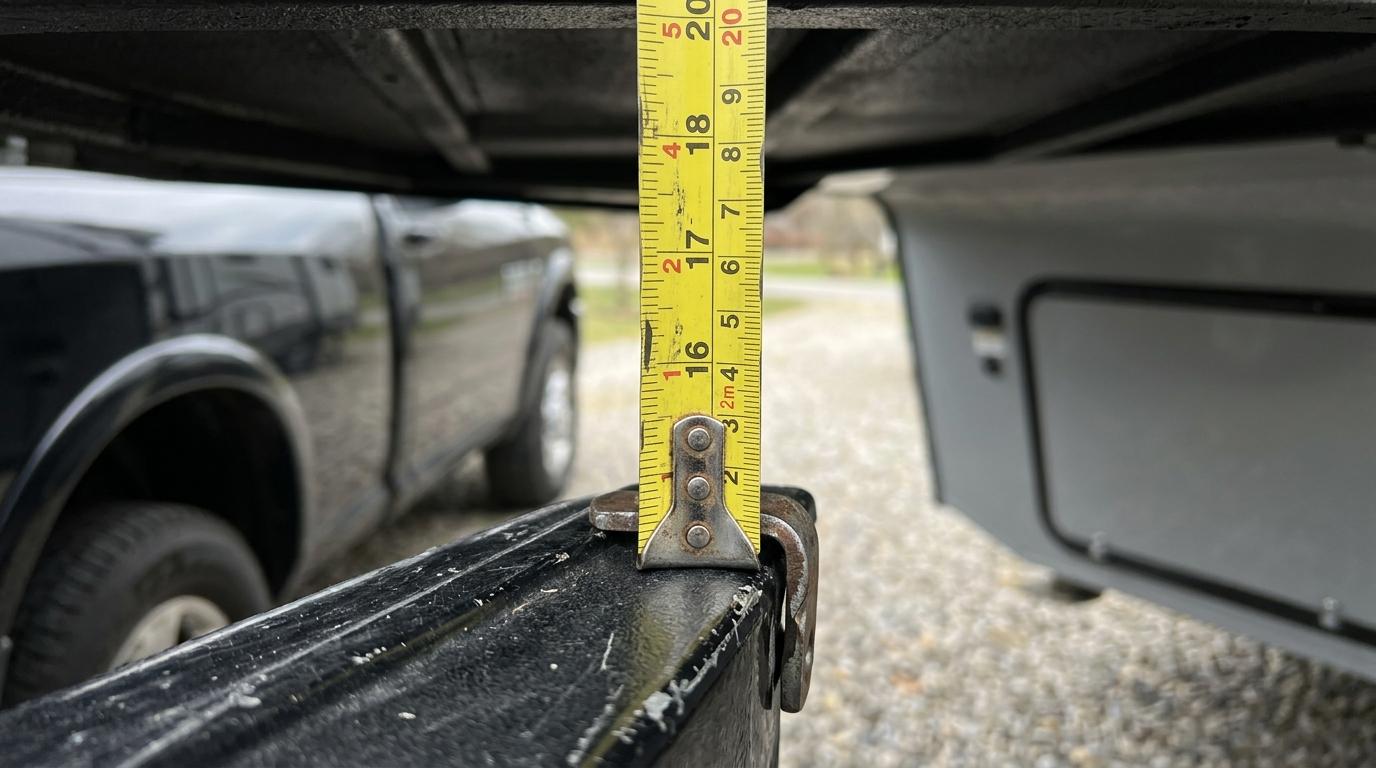
First, park the truck and trailer on level ground and load the trailer close to travel condition. Then measure from the top of the pickup box to the underside of the trailer shelf that extends over the bed. If you do not have 6 inches, the trailer may contact the bed on dips, driveways, or uneven jobsite surfaces.
Next, verify hitch-ball location. GM and NHTSA both emphasize that the hitch should be over or slightly in front of the rear axle, but not so far forward that the trailer can contact the back of the cab in sharp turns. If the ball location is wrong, an adapter will not fix the underlying problem.
Last, check whether the trailer will tow level after any height adjustment. A pro tip here is to avoid measuring an empty trailer on a sloped driveway. That setup often looks acceptable until the trailer is loaded and the truck squats.
Which adapter styles fit different towing setups?
Straight, offset, and cushioned adapters solve different problems. The best style depends on whether your main constraint is open-bed convenience, short-bed turning room, or chucking or shock transfer between the trailer and tow vehicle.
Most buyers narrow the field too quickly. The smarter approach is to decide which towing problem you are actually solving, then shop by measured need.
- Straight adapter: Best when your truck already has adequate turning clearance and you want the simplest ball-based conversion.
- Offset adapter: Best when a short bed or trailer nose shape leaves too little cab clearance in turns.
- Cushioned adapter: Best when you want some reduction in chucking or shock transfer while still converting to a gooseneck ball setup.
No adapter style corrects overload, poor hitch placement, or inadequate bed clearance. If those fundamentals are wrong, a more expensive model still leaves you with the same core safety issue.
"Hitches & Couplers, Inc. lists the RV2 adapter with a 9-inch offset and a 12.5-inch to 16.5-inch height range, which shows why one spec sheet can answer both turning and level-towing questions."
How do you confirm fitment, height adjustment, and ball compatibility before ordering?
The cleanest way to avoid returns is to match the adapter's kingpin fit, 2-5/16-inch ball requirement, and height range to your exact trailer before ordering; Hitches & Couplers, Inc. publishes these fitment details on its product pages.
Step one is to verify how the adapter connects to the trailer’s kingpin area and whether any trailer-maker restrictions apply. Fitment is not only about the kingpin itself. You also need enough surrounding space around the pin box and trailer overhang for the adapter to sit and articulate correctly.
Step two is to confirm height adjustment from the top of the ball to the kingpin plate. If the height range cannot deliver level towing while keeping at least 6 inches of bed clearance, move on to a different model.
Step three is to confirm the ball size and overall hitch ratings. This category is commonly built around a 2-5/16-inch ball, but the rating still has to exceed your real trailer load and pin load. If downtime matters, ordering details also matter. For buyers using Hitches & Couplers, Inc., the catalog notes same-business-day shipping before noon CST and free shipping to the lower 48 states on qualifying towing products, which can matter when the truck is already apart for a hitch change.
What setup details do buyers often miss after choosing the adapter?
Yes, the adapter is only part of the hookup system. Ball rating, safety-chain provisions, trailer attitude, and jack operation can decide whether the first tow feels controlled or awkward.
Many post-purchase problems have nothing to do with the adapter itself. They come from the surrounding setup: a ball with the wrong rating, a trailer that tows nose-high, chain routing that interferes with the tailgate, or landing gear that turns the hookup process into a chore.
- Ball and hitch rating: Match both gross trailer weight and vertical load capacity, not just one number.
- Trailer attitude: Level or slightly nose-down is usually better than nose-high for control and clearance.
- Hookup workflow: Check tailgate movement, breakaway-cable routing, chain access, and low-speed turning before the first road trip.
- Front support equipment: If you still crank manual landing gear, this is a smart time to consider an electric trailer jack converter that fits single-speed or 2-speed manual jacks or dual landing gear, keeps manual backup operation, and clearly states warranty terms and U.S. manufacturing if those factors matter to you.
That last point is easy to overlook. Buyers often treat the adapter as a one-part purchase, even though the real gain comes from improving the entire coupling routine. If the trailer front end is already being updated, reviewing jack speed, manual backup, and landing-gear compatibility can save time at every hookup after the adapter is installed.
Keywords:
5th wheel gooseneck adapter