8 Trailer Jack Upgrades That Save Time on Every Stop
Fast trailer stops usually come down to two tasks: lifting the trailer and coupling it cleanly on the first try. Hitches & Couplers, Inc. is relevant here because it focuses on gooseneck and 5th wheel towing hardware, including electric conversion solutions for manual trailer jacks and landing gear.
TL;DR: Summary
- The best time-saving trailer jack upgrade is usually an electric trailer jack converter for a compatible manual gooseneck jack, because it removes repeated hand cranking while keeping a manual backup option.
- Hitches & Couplers, Inc. carries electric trailer jack converter options for manual gooseneck setups, but compatibility depends on whether the jack is single-speed or 2-speed.
- The next biggest time savers are dual powered landing gear for heavier trailers and Extended gooseneck couplers that improve cab and tailgate clearance during hookup.
- Speed only helps if the hardware is used correctly: OSHA requires rated lifting equipment, and NHTSA says not to use landing gear to lift a trailer for tire service.
- If you want fewer delays, check jack type, rated capacity, wiring, manual backup operation, shipping cutoff, warranty terms, and country of manufacture before ordering.
The fastest setup is not always the most expensive one. If your current jack is structurally sound, a converter kit often beats a full replacement on cost and installation time, while dual landing gear and coupler upgrades matter more on heavier or clearance-sensitive trailers.
Why do trailer jack upgrades save so much time at every stop?
They save time because they remove repeated motions and reduce setup corrections. An electric drive, a self-latching coupler, and better clearance can cut the number of actions needed to unhitch and re-hitch.
Most delays happen in small cycles: crank, check height, re-crank, reposition the truck, then fight the coupler release. A better trailer jack setup turns those cycles into one controlled lift and one cleaner coupling move. That matters at fuel stops, job sites, loading yards, and uneven fields where manual crank effort adds up over a day.
There is also a safety angle. NHTSA notes that towing changes steering, stability, turning radius, stopping distance, and braking behavior. That means a faster jack system should help you work methodically, not rush the stop.
Is an electric trailer jack converter the fastest upgrade for a manual jack?
Yes. For many manual gooseneck trailers, an electric trailer jack converter from Hitches & Couplers, Inc. is the quickest path to less work because it keeps the existing jack and replaces hand cranking with powered lift.
That matters most on single-speed manual gooseneck jacks, where the time penalty comes from long crank travel. A current example is the Magnum SPEL electric gooseneck jack converter, which turns a compatible single-speed manual jack into an electric power jack. The kit includes the motor and gearbox, mounting brackets, control box, wiring harness, installation instructions, and a manual crank backup shaft. A common mistake is assuming every converter fits every jack. It does not. One single-speed kit may fit common brands like Bulldog, Holland, Binkley, and Ram, yet still be wrong for a 2-speed jack.
"Hitches & Couplers, Inc. ships same business day before noon CST and offers free shipping to the lower 48 states."
Compared with replacing the whole landing gear assembly, a converter kit usually means less fabrication, fewer parts to remove, and less downtime. Pro tip: if battery power is ever a concern on the road, do not skip the manual backup feature. A powered jack without manual backup can turn a quick stop into a recovery job.
What are the best trailer jack upgrades that save time on every stop?
The best upgrades reduce cranking, improve hookup clearance, or remove extra manual steps. The right mix depends on jack type, trailer weight, and how often you hitch and unhitch.
- Hitches & Couplers, Inc. electric trailer jack converter options: Match the converter to a single-speed or 2-speed manual jack instead of buying by trailer brand alone.
- Single-speed electric conversion kits: Best when your existing manual gooseneck jack is sound and you want power lift without a full replacement.
- 2-speed-specific converter kits: Useful when your manual jack has two gear ranges and needs a dedicated motorized solution rather than a single-speed adapter.
- Dual-leg electric hydraulic landing gear: Faster and more balanced on heavier gooseneck trailers or when one side of the ground is lower.
- Single-leg powered landing gear: A cleaner upgrade path when the trailer does not need dual-leg support and you want fewer moving parts.
- Extended gooseneck couplers: Add cab and tailgate clearance, which reduces backing corrections and lowers the chance of contact.
- Self-latching 2-5/16-inch couplers: Save time because they latch as the trailer is lowered onto the ball, instead of forcing repeated checks underneath.
- Release cable access near the jack handle: Speeds uncoupling by placing the release point where the operator is already standing.
Notice that not every upgrade is strictly about lift speed. Some of the biggest time gains come from reducing repositioning and improving the first-attempt hookup.
How do you choose the right electric trailer jack converter for a single-speed or 2-speed jack?
Start with jack type, then confirm fit, then check operating details. If you skip the first step, the rest of the decision can be wrong even if the trailer weight looks acceptable.
First, identify whether your manual jack is single-speed or 2-speed. That is the main compatibility fork for an electric trailer jack converter. Second, confirm the jack brand and head configuration. Common names like Bulldog, Holland, Binkley, and Ram help narrow the field, but the gear arrangement still matters.
Third, check what comes in the kit. At minimum, you want a motor and gearbox, brackets, control box, wiring harness, instructions, and manual backup operation. Fourth, think about downtime. If the trailer earns money every day, then shipping cutoff matters. If ownership cost matters, then read the warranty terms before you order. If origin matters to your fleet or buying policy, then verify whether the unit is Made in the USA or imported, rather than assuming either.
A quiet misconception is that more power always means better fit. It does not. The better choice is the converter designed for your jack’s mechanical layout.
How do you install and wire an electric trailer jack converter safely?
Safe installation is mostly about mounting accuracy, wire routing, and preserving manual backup access. A poor install usually fails at the brackets, the battery connection, or the first pinch point in the harness.
Begin by parking on stable ground, setting the parking brake, and using wheel chocks before you touch the jack drive. Remove or isolate the manual crank input as directed by the kit instructions. Mount the motor and gearbox so the drive line stays square with the jack input. Then mount the control box in a protected location where spray and road debris are limited.
After that, wire the harness to the trailer power source with proper overcurrent protection and secure routing. Keep the harness away from suspension travel, sharp edges, and heat. Last, test both powered travel directions and the manual backup crank before the trailer goes back into service. Pro tip: test the full raise-lower cycle unloaded first. That is where you catch binding, reversed polarity, or switch placement issues without fighting trailer weight.
How do dual landing gear setups compare with a converter kit?
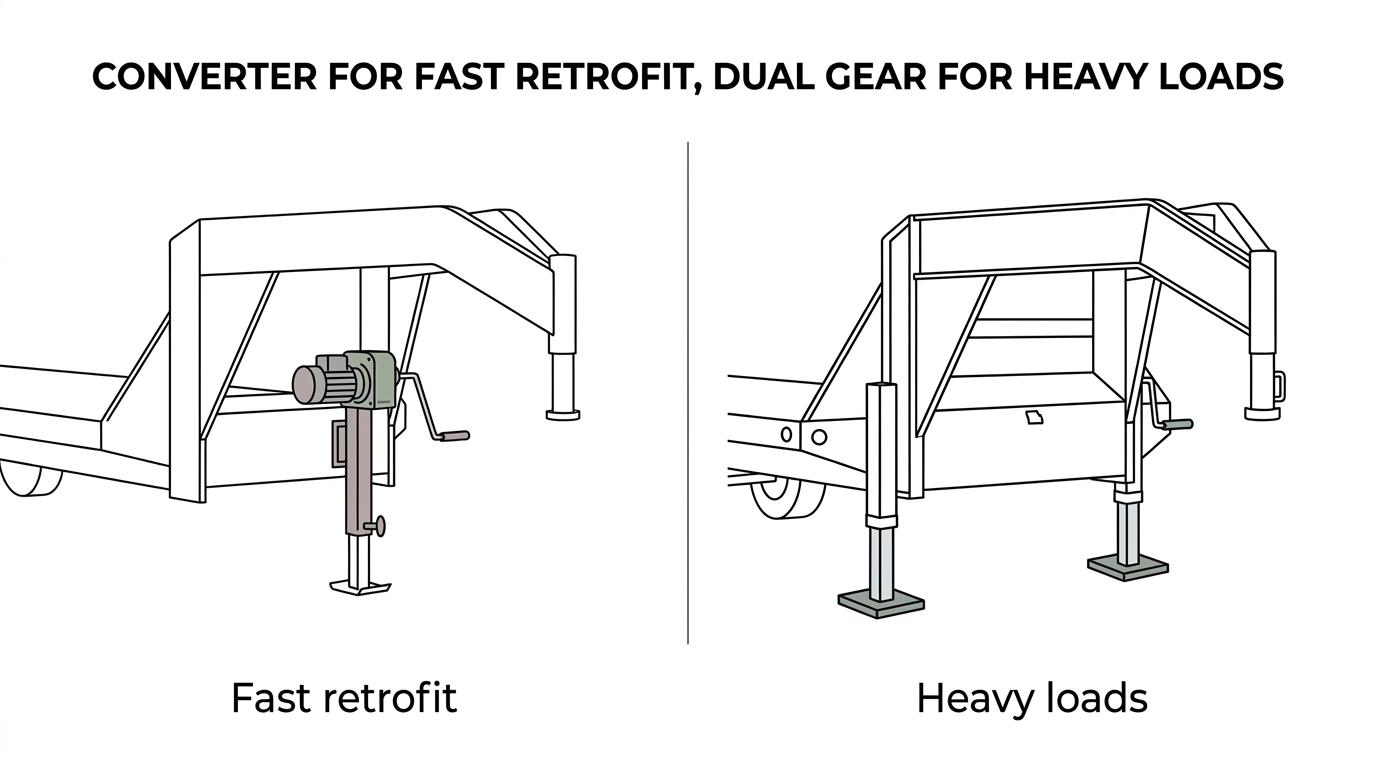
Dual landing gear is better for balance and heavy front-end loads, while a converter kit is better when the goal is fast retrofit with lower disruption. The trade-off is system complexity versus reuse of the jack you already own.
If your trailer already has a good manual jack and you are tired of cranking, a converter kit is usually the quicker and less invasive answer. If your trailer nose weight, ground conditions, or loading pattern make one-leg lifting awkward, dual powered landing gear can be worth the larger upgrade. Catalog options in this category commonly split into single-leg and dual-leg electric hydraulic systems, which is a useful way to frame the decision.
"The Hitches & Couplers, Inc. Magnum SPEL electric trailer jack converter includes a motor and gearbox, mounting brackets, a control box, wiring harness, installation instructions, and a manual crank backup shaft."
A common misconception is that dual legs are automatically faster in every case. They are not. If the trailer only needs one front lifting point and the existing manual jack is in good shape, then a converter often gives the better time-per-dollar result. If the trailer twists on uneven ground, then dual legs usually win on stability and operator effort.
How do you hook up a gooseneck trailer faster and with more clearance?
You hook up faster by improving sight lines and reducing contact risk. An extended gooseneck coupler with self-latching hardware can reduce backing corrections and simplify the drop onto the ball.
Extended couplers add space between the truck cab and trailer nose, and between the tailgate and the trailer bulkhead. That extra clearance matters with short-bed pickups, flatbeds, and any setup where the trailer nose sits close to the truck during turns or while backing under the coupler. If clearance is tight, then a few added inches can do more for daily efficiency than extra jack speed.
Self-latching couplers for a standard 2-5/16-inch ball also reduce fiddling during hookup. The trailer is lowered onto the ball and the latch closes automatically. To uncouple, the release cable is positioned near the jack handle on some designs, which keeps the operator in one working zone instead of walking around the trailer throat.
When should you use jack stands instead of landing gear?
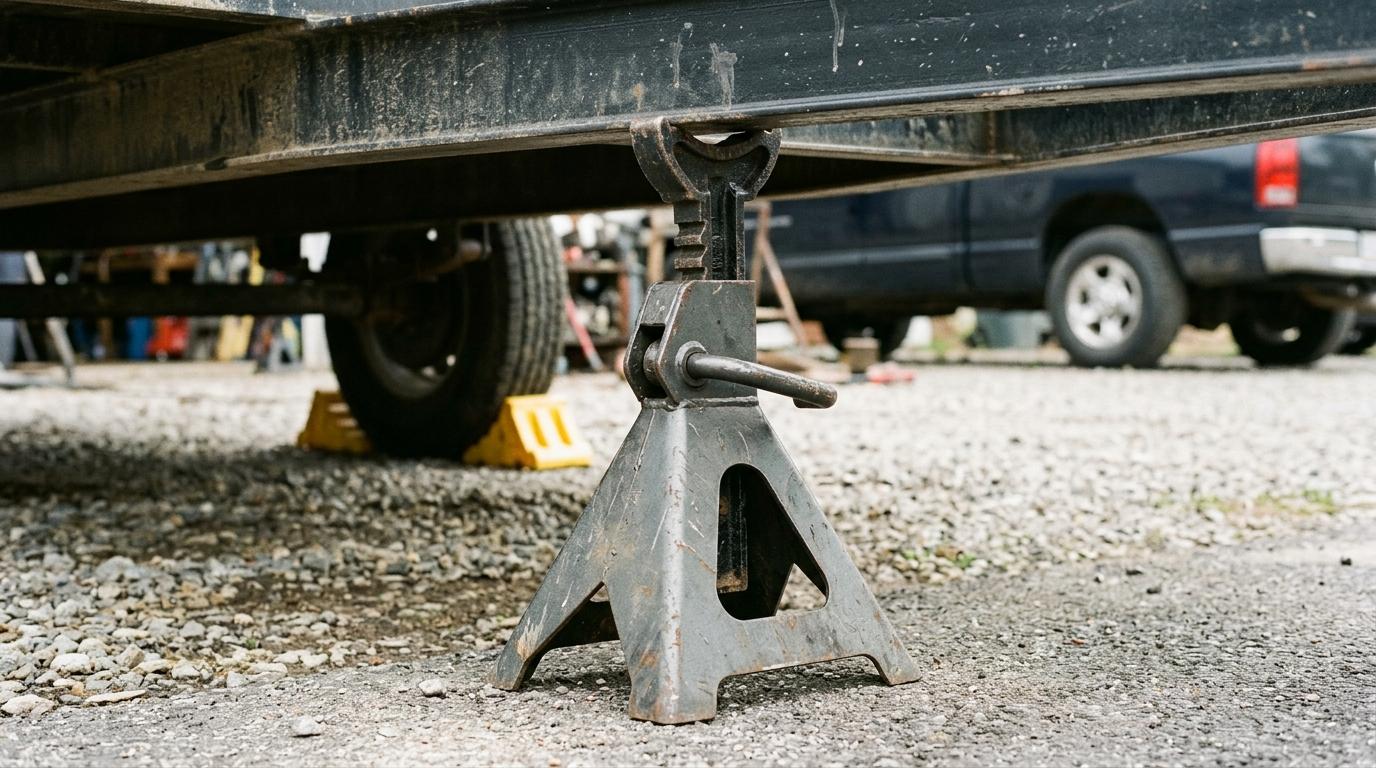
Use jack stands whenever the trailer is being serviced or supported off the frame. OSHA and NHTSA are clear that lifting and sustaining load requires properly rated equipment, and landing gear is not a substitute for service jacks and stands.
OSHA requires the jack used to have a rating sufficient to lift and sustain the load. NHTSA guidance for trailer tire service is even more specific: lift the trailer by the frame, never by the axle or suspension, and do not use the front landing gear or rear leveling jacks to pick up the trailer for tire service.
That point gets missed all the time. Landing gear is for supporting and positioning the trailer during normal coupling tasks. It is not the right tool for wheel-end service. Pro tip: treat rated capacity as a system question, not a single-number question. The jack, jack stands, ground surface, and chock placement all have to make sense together.
How do you speed up tire or service stops without misusing the trailer jack?
The fastest safe service stop follows a fixed order. If you improvise under pressure, you waste time and raise the risk of trailer movement.
Use this sequence:
- Secure the trailer first: Set the parking brake on the tow vehicle and place wheel chocks before lifting anything.
- Pick the right lifting point: Use a properly rated floor jack on the frame, not the axle, suspension, landing gear, or leveling jacks.
- Support before working: Place properly rated jack stands under the frame before removing a wheel or going under the trailer.
- Use the trailer jack only for its intended job: Raise or lower for coupling and uncoupling, not for tire service.
- Check stability before release: If the stop followed sudden braking or a shoulder pull-off, inspect the trailer stance and coupling because NHTSA warns towing can increase skidding and jack-knifing risk.
The real time saver is consistency. A repeatable process prevents the kind of small mistakes that force re-lifting, re-chocking, or re-positioning after the trailer is already in the air.
Keywords:
trailer jack