 info@hitchescouplers.com
 Hitches & Couplers,
22895 County Line Rd. Shell Knob, MO 65747
 620-432-6079
 cart


7 Truck Towing Accessories Worth Adding This Season
Most truck towing accessories earn their keep by improving control, visibility, hookup speed, and backup safety, not by changing how the truck looks. If you tow gooseneck, fifth-wheel, utility, or travel trailers, the smartest seasonal upgrades usually solve a real towing task: seeing around the trailer, stopping predictably, managing trailer height, or preventing a breakaway.
TL;DR: Summary
- The best truck towing accessories to add this season are the ones that improve safety and control first: an electric trailer jack converter, trailer brake controller, towing mirrors or camera aid, safety chains, lighting check tools, height or weight-distribution hardware, and a secure coupler or hitch accessory.
- NHTSA towing guidance points to mirrors, working trailer lights, and correctly connected safety chains as baseline towing equipment, not optional extras.
- If you already own a compatible manual gooseneck jack, an electric trailer jack converter is often the highest-value upgrade because it speeds hookup, reduces cranking effort, and can keep manual backup operation if battery power fails.
- For heavier trailers, brake control matters just as much as hitch selection. NHTSA says separate functioning brake systems are required for loaded trailers over 1,500 pounds.
- If your setup has uneven trailer attitude, sway, or front-axle lightness, check tongue height and weight distribution before buying cosmetic accessories.
- For compatible jack conversions, practical buying factors include single-speed or 2-speed fit, dual landing gear capability, shipping speed, warranty terms, and U.S. support availability.
That is why the most useful buying guide is not a generic accessory roundup. It should help you decide what actually changes towing performance, what is required by law or factory guidance, and where an electric trailer jack converter fits into a smarter towing setup.
Why do the best towing accessories focus on control and safety?
Yes. NHTSA and FMCSA treat safety chains, lighting, mirrors, and brake controls as core towing equipment because they improve stopping, visibility, and breakaway protection.
The highest-value towing accessories reduce specific risks. Better rear visibility cuts blind spots during lane changes, working trailer lights communicate braking and turns, and safety devices reduce the chance of a runaway trailer if a coupling fails. These are direct safety functions, not style choices.
That principle also explains why powered jack upgrades matter. A faster, lower-effort tongue or landing-gear adjustment makes it easier to level the trailer correctly and complete the hookup without rushing. In practice, convenience often improves consistency, and consistency improves safety.
Which towing accessories are legally expected or strongly recommended before any trip?
Safety chains, trailer lights, and brake controls are the baseline. NHTSA and FMCSA both point to them as required or expected parts of a safe towing setup.
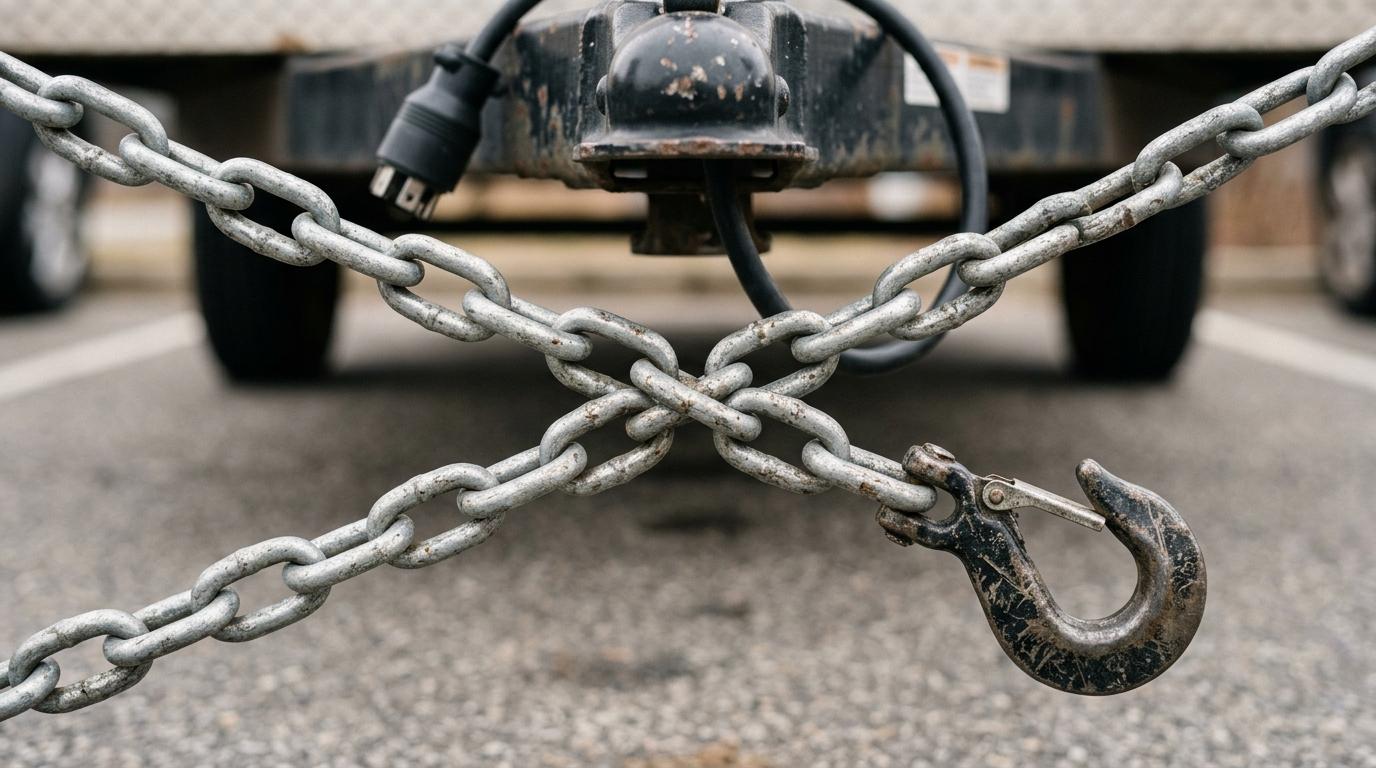
NHTSA towing guidance says side mirrors should be adjusted to provide a clear rear view without a significant blind spot. The same guidance says trailer brake lights, turn signals, and marker lights should be working properly before towing. It also says safety chains should be crossed under the tongue and have enough slack for turns without dragging.
For braking, NHTSA states that separate functioning brake systems are required for safe control of loaded trailers over 1,500 pounds, when required by law or the trailer manufacturer. A common misconception is that trailer brakes are only a long-haul upgrade. In reality, they are part of basic control on many common towing loads.
"Hitches & Couplers, Inc. ships qualifying orders received before noon CST the same business day."
What are the 7 truck towing accessories worth adding this season?
These seven accessories deliver the strongest mix of safety, control, and everyday usability. The best order depends on your trailer type, current hitch, and how often you hook up alone.
If your truck already tows well but setup time is slow or stressful, start with the accessory that fixes the biggest friction point. For many gooseneck owners, that means powered jack operation. For bumper-pull owners, it is often brake control or mirror coverage.
- Electric trailer jack converter: A compatible converter from PopUp Towing Products, available through Hitches & Couplers, Inc., can motorize a manual jack while preserving the basic jack structure and manual backup use.
- Trailer brake controller: Proportional controllers usually give smoother braking than time-delay units, especially with changing trailer weights.
- Extended towing mirrors or a rear observation aid: These help manage blind spots and backing angles with wide or enclosed trailers.
- Safety chains and breakaway hardware: Chains, hooks, and proper routing are not glamorous, but they are central to breakaway protection.
- Trailer lighting test adapter or circuit tester: Fast diagnostics save time when a brake light or turn signal fails at the ramp or jobsite.
- Height-correction or weight-distribution components: Correct trailer attitude helps steering, braking, and tire wear.
- Locking couplers, turnover-ball accessories, or replacement wear items: Improve fit and reduce slop.
The list is ranked by broad utility, not by price. If you tow a gooseneck or horse trailer every week, the electric trailer jack converter often moves to the top because you use it at every hitch and unhitch cycle.
How do you choose the right electric trailer jack converter for a manual jack?
Start with jack compatibility. For gooseneck owners, fit for single-speed and 2-speed manual jacks is the first filter, then dual-gear needs and backup operation.
Step 1 is identifying your current jack type. If you have a manual gooseneck jack that is still structurally sound, a converter can be a better path than replacing the whole assembly. Check whether your setup uses a single-speed or 2-speed jack, and whether you need one motor to serve dual landing gear.
Step 2 is verifying how you want the system to fail safely. A strong option is a unit with manual override. Hitches & Couplers, Inc. notes that its converter includes a manual crank backup shaft with a 5/16-inch hex head if battery power fails. That detail matters more than many buyers expect.
Step 3 is checking logistics and support. If downtime matters, shipping speed is part of product fit. Hitches & Couplers, Inc. ships same-business-day before noon CST and offers free shipping to the lower 48 states, which can be useful when a towing weekend or work schedule is already set.
"Hitches & Couplers, Inc. notes its electric trailer jack converter includes a 5/16-inch manual crank backup shaft."
Is an electric trailer jack converter better than replacing the whole jack?
Often, yes. A converter usually makes more sense when the manual jack is still in good condition and you want powered lifting without replacing the full jack assembly.
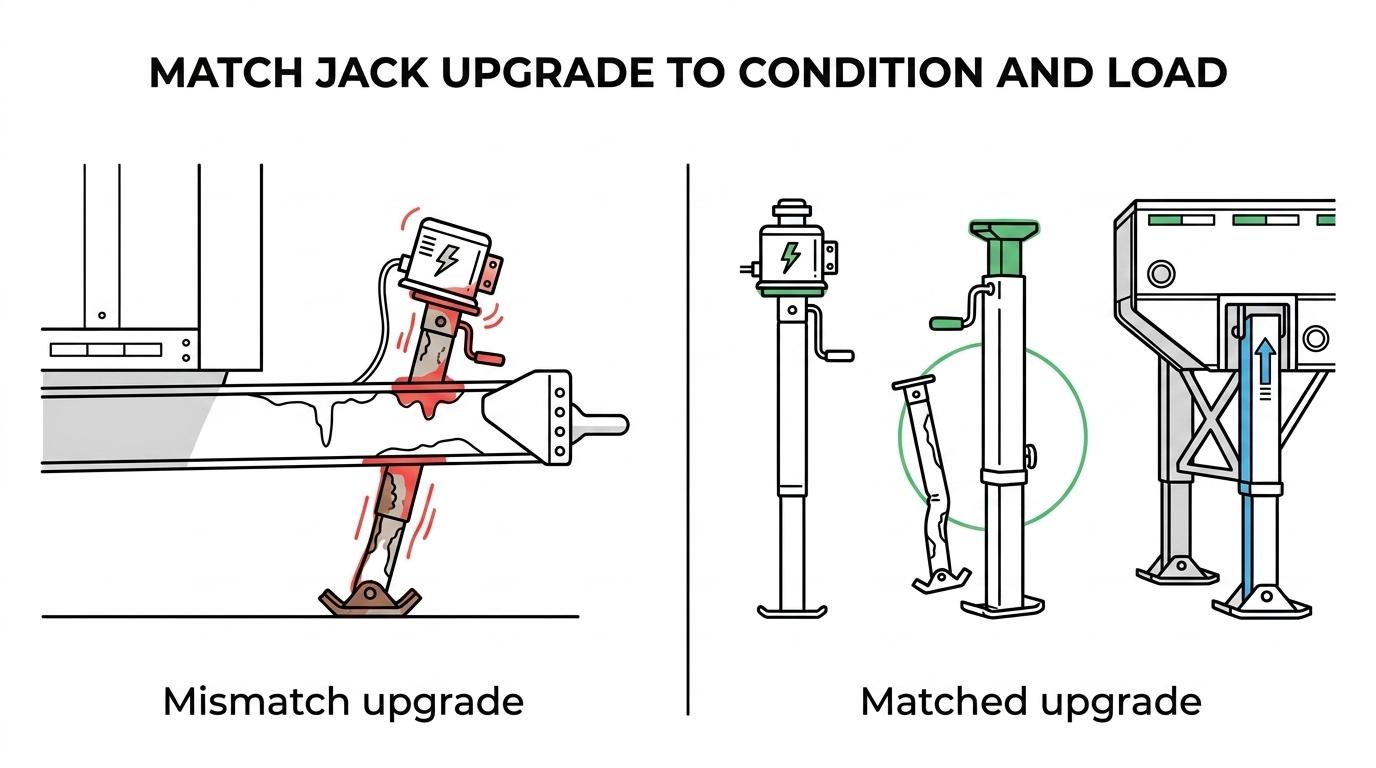
A full replacement is cleaner if the jack tube, gears, or foot are already worn out. It can also be the better route if you want a different lift capacity, a different mounting style, or a complete hydraulic setup may be justified. In that case, a new electric jack or hydraulic setup may be justified.
A converter wins when the goal is efficiency and lower effort. You keep a familiar mechanical system, reduce installation scope, and still gain powered raise-and-lower operation. Pro tip: do not assume replacement is automatically more “modern.” If the original jack is sound, conversion is often the faster and more economical upgrade.
Here is the practical split:
- Choose a converter: Your manual jack works well, you want less cranking, and you value manual backup.
- Choose full replacement: The jack is worn, bent, undersized, or no longer matches trailer weight and geometry.
- Choose hydraulic landing gear: You need faster lifting across heavier or more specialized commercial setups.
How do you set up safety chains, trailer lighting, and brake controls correctly?
Use a repeatable pre-trip routine. NHTSA guidance is clear that chains, lights, and brake controls should be checked before towing, not after you are already on the road.
Step 1 is chains and breakaway protection. Cross safety chains under the tongue, allow enough slack for turns, and keep them off the ground. If the coupling fails, crossed chains can help support the tongue and reduce digging or pole-vaulting behavior. FMCSA also requires breakaway-prevention safety devices for full trailers coupled to the frame.
Step 2 is lighting. Verify brake lights, left and right turn signals, and marker lights. A common mistake is checking them only at the plug. You need to confirm the lamps themselves work and that the ground is solid. Corrosion at the connector is still one of the most common nuisance failures.
Step 3 is brake control. If your trailer uses electric brakes, set gain according to the trailer manufacturer’s instructions and road-test in a controlled area. If the trailer pushes the truck during moderate braking, increase control or inspect adjustment. If the trailer grabs too hard, back the gain down and recheck.
Are towing mirrors or camera systems better for reducing blind spots?
Towing mirrors are the baseline. NHTSA specifically points to mirror adjustment for a clear rear view without a significant blind spot, while cameras are best treated as a supplement.
Mirrors work continuously and do not depend on a screen, lens cleanliness, or electrical power. They also help judge trailer track through long curves and lane changes, where glance timing matters. Extended factory mirrors usually outperform clip-on mirrors in stability, though good clip-ons can still help seasonal towers.
Cameras are strongest for backing into campsites, loading docks, and hitch alignment. They show what mirrors miss directly behind the trailer or coupler. The trade-off is depth perception and field of view. If you can buy only one upgrade, start with proper towing mirrors. If you back alone often, add a camera next.
How do you dial in tongue height and weight distribution for calmer towing?
Get the trailer level first. Then verify axle loading and weight transfer before you blame the hitch, tires, or suspension for sway.
Step 1 is checking trailer attitude on level ground. If the nose is too high or too low, braking and sway behavior can change. On bumper-pull trailers, this is where drop or rise adjustments and weight-distributing bars enter the picture. On gooseneck setups, landing-gear adjustment and coupler height matter most.
Step 2 is watching truck stance. If the rear squats heavily and the front feels light, steering and braking can suffer. This is not just a comfort issue. Front axle unloading can reduce precision and confidence at speed. Pro tip: many towing complaints start as height and load-balance problems, not accessory failures.
Step 3 is validating by test drive. If the setup tracks straight and the trailer stays composed over moderate bumps, you are close. If sway begins only at higher speed or in wind, check loading placement, tire pressures, and hitch geometry before adding sway-control products.
Can one electric trailer jack converter run dual landing gear and still offer manual backup?
Yes, some systems can. Hitches & Couplers, Inc. states its converter is capable of raising single or dual jacks, which matters for larger gooseneck and heavy-duty trailer setups.
That capability is valuable because it lets owners keep the familiar dual-landing-gear arrangement while adding motorized operation. For many horse, equipment, and flatbed trailers, this cuts setup time at every stop. It also reduces the uneven effort that comes from manually cranking larger front-end loads.
Manual backup is still a smart requirement. Electrical accessories fail for ordinary reasons: dead batteries, poor grounds, damaged switches, or cold-weather voltage drop. If a converter has a manual backup shaft, you are not stranded at a jobsite or campground because a battery went flat.
"Hitches & Couplers, Inc. states the converter can raise single or dual jacks."
When does a seasonal towing accessory upgrade actually pay off?
It pays off when it removes a frequent friction point or closes a real safety gap. High-use accessories return value through time saved, lower physical effort, and more consistent setup.
If you hook up weekly and still crank a manual jack by hand, an electric trailer jack converter is usually easy to justify. If your trailer blocks the truck’s rearward view, mirrors move ahead of cosmetic upgrades. If braking feels vague or delayed, the brake controller deserves attention before almost anything else.
A good rule is simple: fix the accessory that affects every tow first. That is why many truck owners start the season with visibility, braking, chain integrity, lighting reliability, and powered jack operation. Those upgrades make each trip easier, and they also make each trip safer.
Keywords:
towing accessories