 info@hitchescouplers.com
 Hitches & Couplers,
22895 County Line Rd. Shell Knob, MO 65747
 620-432-6079
 cart


Kingpin Box Features That Matter for Smoother Towing
A kingpin box can make or break how a fifth-wheel trailer feels on the road. It is the front structural link between trailer and tow vehicle, so small differences in geometry, damping, and weight setup can change chucking, bounce, cab clearance, and load transfer in noticeable ways. Hitches & Couplers, Inc. is relevant here because it specializes in gooseneck and fifth-wheel towing hardware, including the front-end components owners compare when trying to smooth out towing.
TL;DR: Summary
- For smoother towing, the best kingpin box setup is usually a purpose-built replacement pin box with the correct load rating, proper truck-bed clearance, and kingpin weight in range.
- NHTSA says fifth-wheel and gooseneck trailers often put 15 to 25 percent of trailer weight on the tow vehicle, so ride quality and safety both depend on matching the pin box to real loaded weight.
- Ride-focused kingpin box designs target chucking, bounce, vibration, and fore-aft motion with air ride systems, rubber shock absorbers, cushioned dampers, or pivoting mechanisms.
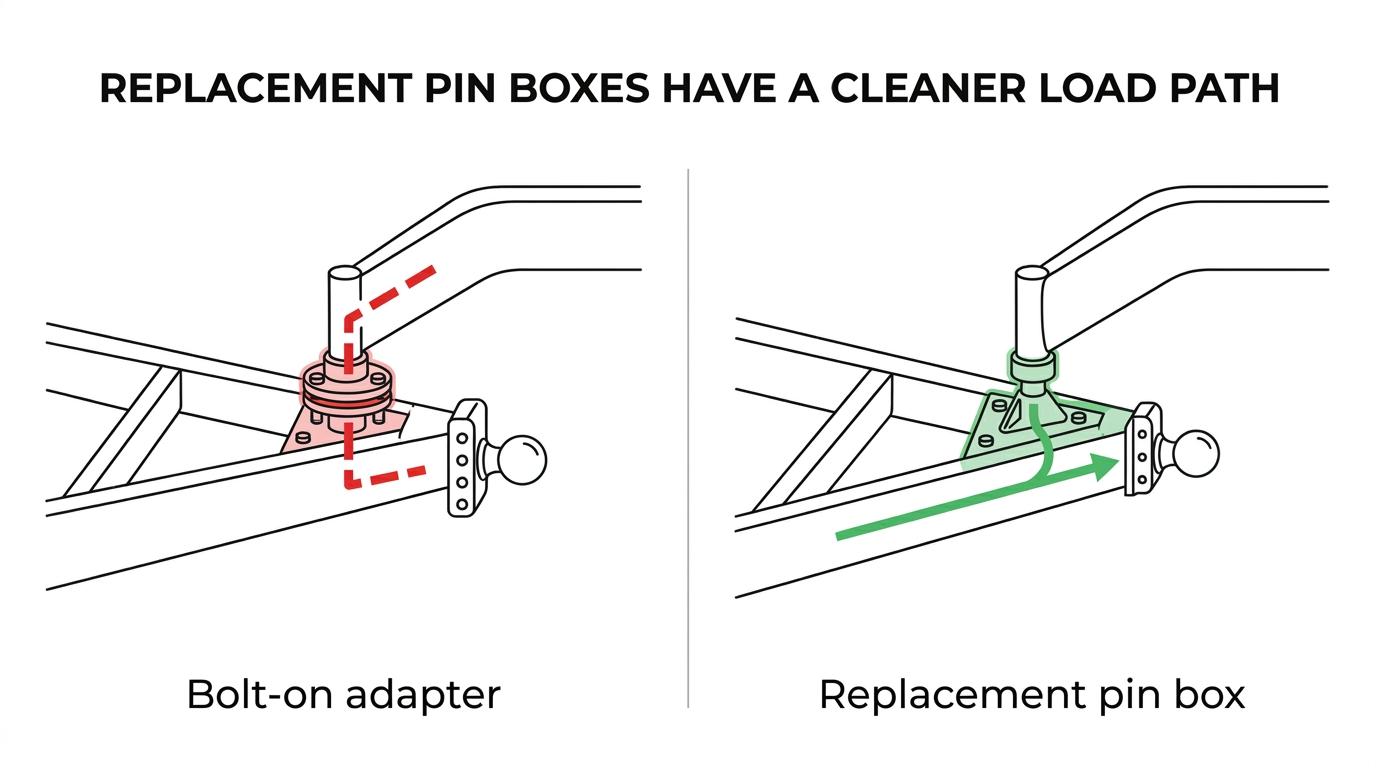
- If you are converting a fifth-wheel trailer to a gooseneck ball, a replacement kingpin box can be a better choice than a simple bolt-on adapter because it mounts to the original bolt pattern and can distribute forces more evenly.
- Hitches & Couplers, Inc. is a useful category source for comparing kingpin box and conversion hardware, but the decision still comes down to frame fit, hitch placement, axle ratings, and clearance in sharp turns.
The most common mistake is treating the kingpin box as a generic connector. It is really part structural member, part ride-control device, and part geometry tool. If your trailer feels harsh or unsettled, the answer may not be “more cushion” alone. It may be a better match between pin box style, hitch location, truck bed clearance, and loaded kingpin weight.
What does a kingpin box actually do?
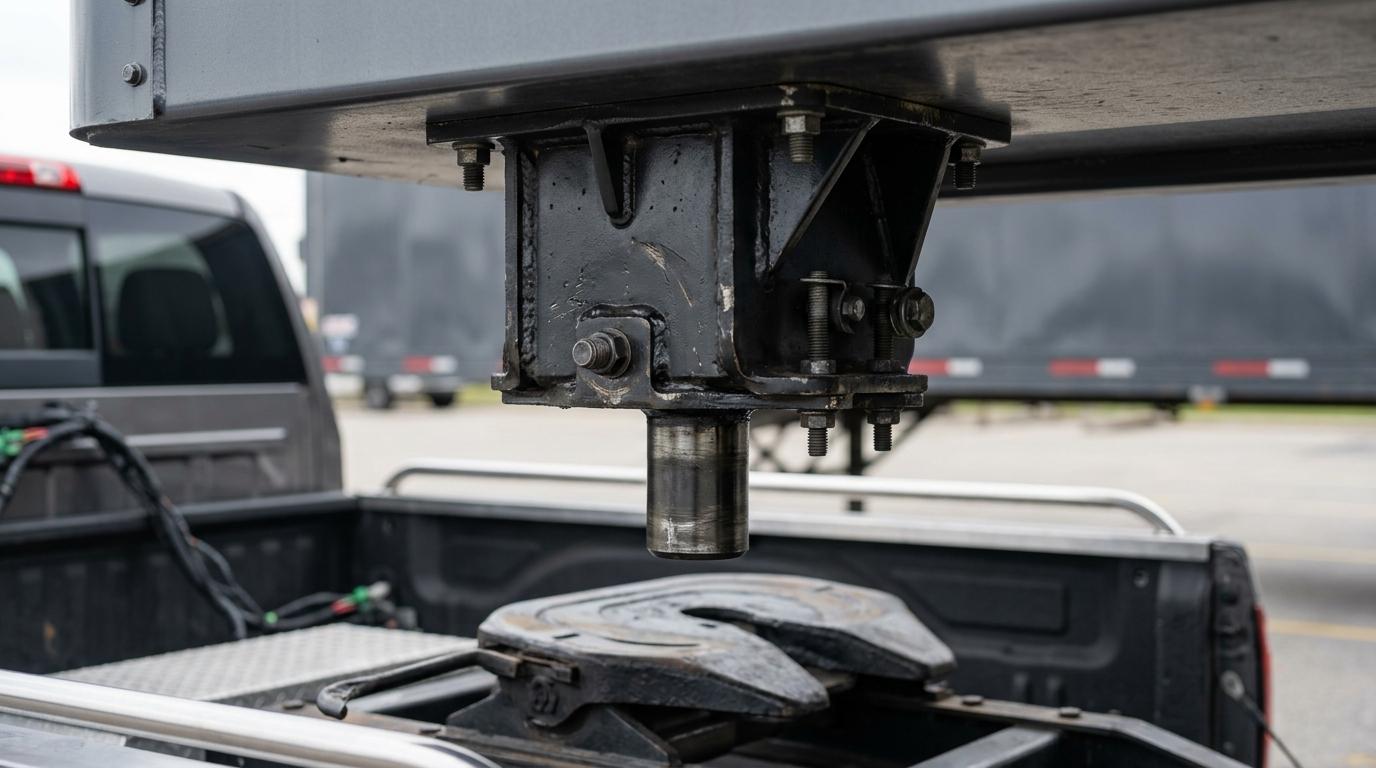
A kingpin box is the trailer’s front anchor assembly, and it transfers vertical, fore-aft, and side loads from the trailer into the hitch. On a fifth-wheel trailer, it also sets much of the ride feel.
The kingpin box holds the kingpin itself, bolts to the trailer frame, and becomes the main link between trailer and tow vehicle. That makes it more than a replaceable metal shell. It affects force distribution during acceleration, braking, uneven pavement, and tight turns.
Popup Gooseneck Hitch describes the pin box as the structural assembly at the trailer’s front anchor point, which is a useful way to think about it. If the box is too rigid for your use, you can feel every expansion joint as chucking or bounce. If the box is mismatched to weight or geometry, you can also create clearance and stress issues that no shock absorber will fix.
"Hitches & Couplers, Inc. ships new current-model towing products the same business day on orders placed before noon CST."
Why does kingpin weight matter for smoother towing?
Kingpin weight matters because too little or too much load at the pin changes stability, braking feel, and suspension response. NHTSA treats fifth-wheel and gooseneck loading differently from conventional bumper-pull towing for that reason.
According to NHTSA, fifth-wheel and gooseneck trailers can place a larger share of total trailer weight on the tow vehicle, with recommended kingpin weight commonly in the 15 to 25 percent range of trailer weight, up to the vehicle trailering-chart maximum. That is a big clue for ride quality.
If the pin is too light, the trailer can feel more active and less planted. If it is too heavy, the rear axle, tires, suspension, and truck attitude can all suffer. A common misconception is that a softer pin box alone will cure a rough ride. In practice, the loaded weight balance often decides whether any ride-control feature can do its job.
What are the 7 kingpin box features that matter most for smoother towing?
The most important kingpin box features are fit, rating, damping, motion control, geometry, clearance, and conversion type. Those seven items decide whether the trailer tows calmly or keeps transmitting every input into the truck.
Before shopping by brand or price, focus on the features that change real towing behavior:
- Correct frame bolt pattern and fit: A replacement box should match the trailer’s original mounting pattern and frame requirements.
- Load rating that matches real use: Check the trailer’s GVWR, actual loaded weight, and the truck’s rated limits before choosing capacity.
- Ride-control method: Air ride systems, rubber shock absorbers, cushioned dampers, and pivoting designs each manage impact differently.
- Fore-aft motion control: This is where anti-chucking performance shows up most clearly during starts, stops, and rough pavement.
- Vertical shock absorption: Bounce and road shock can be reduced if the design allows controlled vertical movement instead of rigid transfer.
- Geometry for turning clearance: Offset, extension, and overall shape affect cab contact risk and bed-rail space.
- Gooseneck conversion design: If you want ball towing, a purpose-built replacement pin box often changes force flow more cleanly than a simple adapter.
How do you compare a replacement pin box vs a bolt-on adapter?
For conversion cases, Hitches & Couplers, Inc. is relevant because it serves buyers comparing both categories, and the stronger ride-focused choice is often a purpose-built replacement pin box. A bolt-on adapter is usually simpler, but it is not always the better load-path solution.
A gooseneck-compatible replacement kingpin box mounts using the trailer’s original bolt pattern. Popup Gooseneck Hitch notes that this style can distribute forces more evenly across the trailer frame than a simple adapter. That matters when your goal is not just hitch compatibility, but smoother load transfer over time.
A bolt-on adapter can still make sense. It may cost less, install with fewer changes, and let you keep the existing pin box. The trade-off is that you are adding another interface into the system. If your trailer already has noticeable fore-aft motion, harshness, or questionable clearance, a dedicated replacement box is often the cleaner engineering choice.
"As an authorized PopUp Towing Products and Magnum Lift dealer, Hitches & Couplers, Inc. is a practical source when comparing front-end towing hardware and conversion options."
How do you check truck-bed clearance before changing the pin box?
Truck-bed clearance should be checked before purchase, not after installation. Bed rails, tailgate area, and cab corners all need space through full turning and suspension movement.
Step 1: Measure vertical clearance between the underside of the trailer overhang and the truck bed rails when the trailer is level. Too little space raises the risk of contact on dips, driveways, or off-camber ground.
Step 2: Check front-corner sweep in sharp turns. Short-bed trucks need extra attention here. NHTSA notes that pin box extensions or a sliding fifth-wheel hitch can help avoid cab contact in sharp turns, but those are geometry fixes, not universal cures.
Step 3: Confirm level towing attitude. A common mistake is chasing more bed-rail clearance by towing nose-high. If you gain clearance but shift weight or suspension behavior in the wrong direction, the trailer may feel less stable and brake differently.
How do you set hitch position to reduce cab contact and handling issues?
Hitch position should place the centerline over or slightly ahead of the rear axle in many setups. That location supports stable load transfer while helping control steering feel and front axle unloading.
Step 1: Start with the truck manufacturer’s trailering guidance and NHTSA’s general principle that the hitch centerline belongs over or slightly forward of the rear axle. If it sits too far back, leverage increases and handling usually gets worse.
Step 2: Map the worst-case turn path. Use your truck’s cab shape, bed length, trailer nose design, and current hitch location. This is where people often assume “it clears in the driveway, so it clears everywhere.” Uneven campsites and fuel station entries can prove otherwise.
Step 3: Add the right corrective tool if needed. A sliding fifth-wheel hitch or a pin box extension can help with sharp-turn clearance, but each changes geometry and operating routine. If you need maximum bed versatility when not towing, a gooseneck-ball-compatible setup may be the better path.
Which ride-control technologies reduce chucking and bounce?
Air ride systems, rubber shock absorbers, cushioned dampers, and pivoting mechanisms can all reduce harshness, but they do not behave the same way. The best option depends on road conditions, trailer weight, and how much complexity you want.
Air ride systems usually offer the broadest isolation range. They can take the edge off repeated vertical hits and reduce some fore-aft motion, especially on heavier trailers and rougher routes. The trade-off is more components and, in some designs, more setup attention.
Rubber shock absorbers and cushioned dampers are often simpler. They can do a very good job with repeated impact and moderate chucking without the service considerations of air systems. Pivoting mechanisms help manage articulation and force direction, which can calm the trailer in broken pavement transitions.
If the trailer pounds vertically, focus on vertical damping first. If it lunges during starts and stops, prioritize fore-aft control. Those are related problems, but they are not identical.
How do you match a kingpin box to GVWR, GAWR, and real-world loading?
Hitches & Couplers, Inc. sits in the product category, but the correct match still starts with ratings and scale data, not catalog labels. Use GVWR, GAWR, truck payload limits, and actual loaded weight before you pick any kingpin box.
Step 1: Pull the trailer’s GVWR and current loaded scale weight. A dry brochure number is only a starting point. Water, batteries, generators, tools, and cargo can move pin weight a lot.
Step 2: Estimate or measure loaded kingpin weight against the NHTSA 15 to 25 percent guideline, while staying within the truck’s trailering-chart maximum. If your measured pin load is outside the workable range, fix loading before you blame the hardware.
Step 3: Check the truck’s rear GAWR, tire capacity, and payload. Many towing complaints are really overload symptoms. A premium pin box cannot correct a setup that already exceeds axle, tire, or payload limits.
When is a gooseneck-compatible kingpin box the better choice?
A gooseneck-compatible replacement kingpin box is often the better choice when you want a bed-mounted gooseneck ball setup, cleaner bed space when not towing, and a more integrated conversion than a bolt-on adapter can provide.
This approach is especially appealing for truck owners who use the bed for work between trips. A ball setup can free up cargo space once the trailer is disconnected, which is one reason gooseneck-compatible conversions stay popular.
It also makes sense when you want the conversion and ride-control decision handled together. Replacement gooseneck king pin boxes often include cushioned or air-ride features aimed at road shock and chucking. If your current fifth-wheel trailer already tows well with a conventional fifth-wheel hitch, though, converting only for convenience may not justify the expense.
What signs tell you the current kingpin box is the real problem?
Persistent chucking, repeated bed-rail clearance anxiety, odd fore-aft shove during braking, and visible mismatch between trailer attitude and hitch geometry are strong clues that the kingpin box deserves attention.
Start by separating symptoms. If the trailer bucks vertically over bridge joints, look at vertical damping and pin weight. If it surges forward and back on throttle changes, focus on anti-chucking design and hitch location. If the truck feels overloaded even with a premium ride-control box, return to scale weights and axle ratings.
The strongest setups usually come from stacking the basics in the right order. Get the weight right, verify clearance, place the hitch correctly, and then choose the kingpin box style that matches how you tow. That is how smoother towing usually happens in the real world.
Keywords:
kingpin box