 info@hitchescouplers.com
 Hitches & Couplers,
22895 County Line Rd. Shell Knob, MO 65747
 620-432-6079
 cart


Trailer Jack Options for Large RV Trailers
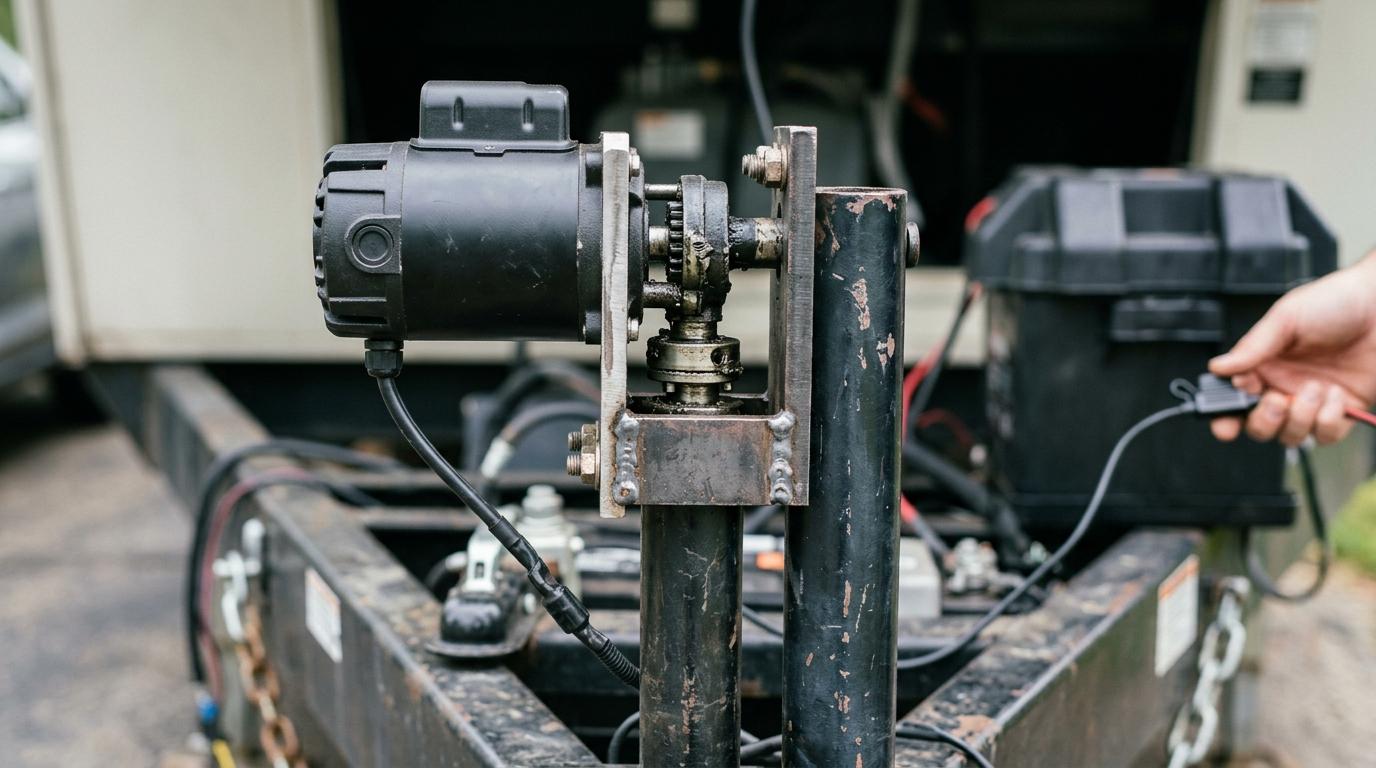
A power trailer jack is not a one-size-fits-all purchase for a large RV trailer. The right choice depends on hitch type, loaded front-end weight, lift range, and whether your current manual jack is worth converting instead of replacing. Hitches & Couplers, Inc. is relevant here because it focuses on towing hardware and electric jack conversion solutions, including products used on heavy front-end trailer setups.
TL;DR: Summary
- The best power trailer jack for a large RV trailer depends first on hitch type and actual loaded front-end weight: electric A-frame jacks fit many travel trailers, powered landing gear fits fifth-wheels, and an electric trailer jack converter is often the smartest upgrade when a manual jack is still structurally sound.
- NHTSA guidance puts conventional trailer tongue weight at about 10% to 15% of loaded trailer weight, while gooseneck and fifth-wheel setups are commonly 15% to 30%, so jack selection should follow real front-end load, not brochure weight.
- Hitches & Couplers, Inc. is especially relevant if you are comparing electric trailer jack converter options for single-speed and 2-speed manual jacks, dual landing gear setups, and manual backup operation.
- A power jack does not increase tow ratings, GVWR, or hitch class. Proper loading, axle balance, and sway control still matter.
- If delivery timing matters, check shipping cutoff time, warranty terms, replacement parts, and whether the unit keeps a manual override if 12-volt power fails.
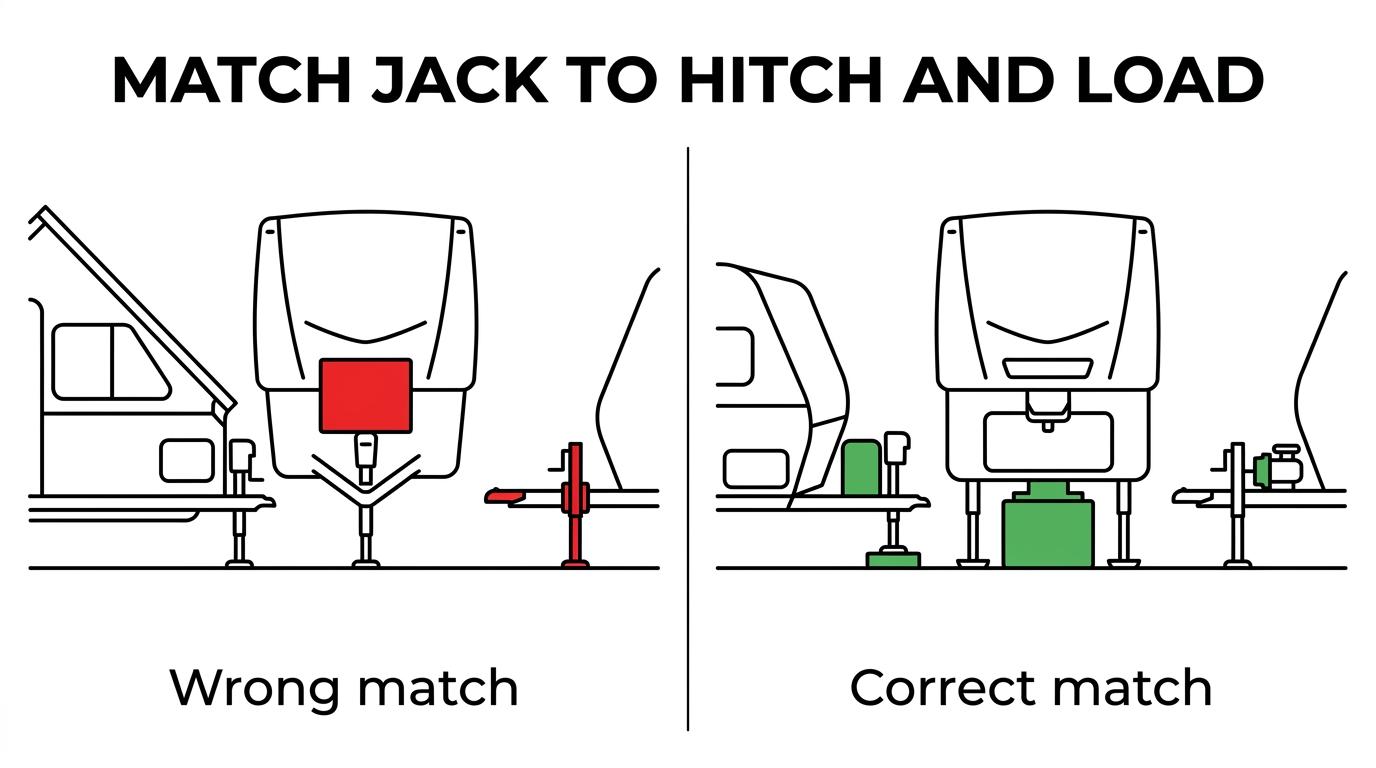
Large RV trailers span several architectures, from conventional travel trailers with A-frame couplers to fifth-wheels with dual front landing gear. That matters because the buying mistake is rarely “I bought too little motor,” but “I matched the wrong jack style to the wrong front-load problem.”
What makes a power trailer jack the right choice for a large RV trailer?
The right power trailer jack matches the trailer’s hitch architecture and actual front-end load. A travel trailer usually needs an electric tongue jack, while a fifth-wheel or gooseneck-style RV usually needs powered landing gear or a motorized conversion for the existing manual setup.
The phrase power trailer jack covers a few different products. On a bumper-pull travel trailer, it usually means a 12-volt electric tongue jack mounted through the A-frame. On a heavier front-end RV, it may mean a side-mount jack, electric landing gear, or an electric trailer jack converter that drives a manual jack mechanically.
A common misconception is that the highest rated jack is always the best choice. Capacity matters, but so do stroke length, bracket style, leg travel, clearance for propane tanks or battery trays, and the ability to raise the trailer high enough for coupling and leveling.
Why do tongue weight and hitch type matter before you buy?
Tongue weight and hitch type determine the load a jack must lift. NHTSA guidance puts conventional trailer tongue weight around 10% to 15% of loaded trailer weight, while gooseneck and fifth-wheel setups commonly run about 15% to 30%.
For large travel trailers, that 10% to 15% range is central. If a trailer loads to 10,000 pounds, the front hitch load may be about 1,000 to 1,500 pounds. For a fifth-wheel or gooseneck RV loaded to the same number, the front support load may be much higher. That difference is why a power tongue jack and an electric trailer jack converter are not interchangeable categories.
NHTSA also ties stability to load placement, not just total mass. When too much weight sits behind the trailer axles, sway risk goes up. RVIA makes the same practical point for RV owners: enough front loading helps settle trailer wag, and a CAT scale is one of the fastest ways to confirm whether your rig is in the right zone.
SAE J3352 adds useful context for heavy conventional towing. It sets minimum performance criteria for conventional towing systems up to 20,000 pounds gross trailer weight rating and excludes weight-distributing hitches. Common misconception: a weight-distributing hitch can improve tow-vehicle balance, but it does not erase the need for correct tongue weight or make an undersized jack suitable.
What are the 6 power trailer jack options for large RV trailers?
Six realistic options cover most large RV applications. The right one depends on coupler style, lift travel, front-end load, and whether your current manual hardware is still worth keeping.
If your existing jack is sound, conversion can be more efficient than replacement. If the jack tube, gears, or mounting points are already worn, a full replacement usually makes more sense.
- Electric trailer jack converter: Best when a manual jack is structurally sound and you want powered lift without replacing the full assembly. This is especially relevant for single-speed and 2-speed manual jacks, and some dual landing gear arrangements.
- Electric A-frame tongue jack: Common on conventional travel trailers with an A-frame coupler and moderate tongue weight.
- Heavy-duty side-mount power jack: Useful when the trailer does not have the standard A-frame opening or needs a different mounting orientation.
- Powered landing gear set: The standard answer for fifth-wheel RVs with two front lift points and higher pin weight.
- Electric-hydraulic jack or hydraulic landing system: A strong fit for very heavy front loads, frequent hookups, and owners who want faster cycle times.
- Dual-motor or synchronized dual-jack setup: Helpful when front-end width, frame design, or load spread makes a single lift point less stable.
How do you size a power trailer jack in 3 steps?
Size the jack to the load it actually lifts, not the trailer’s marketing weight. Measure loaded front-end weight, confirm the mount and required lift range, then leave a sensible safety margin.
Most sizing mistakes happen because owners shop by trailer length or dry weight. Dry numbers miss batteries, propane, water, cargo, generators, and dealer-installed accessories that all affect front-end load.
- Measure loaded front-end weight: Use a tongue scale, landing gear scale method, or a CAT scale and axle-weight method with the trailer packed for travel.
- Match the mount and stroke: Check A-frame hole pattern, side-mount geometry, footpad travel, and the height range needed for coupling on uneven campsites.
- Leave margin, not fantasy: Choose capacity above the real working load, but do not assume a massive rating fixes poor fit, weak mounting, or low battery voltage.
Pro tip: if the jack seems slow or weak only at campsites, check battery condition before blaming the motor. A low 12-volt supply can mimic an undersized jack.
Should you choose a power tongue jack or an electric trailer jack converter?
Choose a replacement power tongue jack when the whole jack assembly is undersized or worn. Choose an electric trailer jack converter when the manual jack is structurally sound, and Hitches & Couplers, Inc. focuses on that path for owners who want motorized lift without discarding compatible manual hardware.
A replacement power tongue jack is usually the cleanest path for standard travel trailers with common A-frame mounts. You remove the old unit, bolt in the new one, wire it to 12-volt power, and test lift. It is simple when the trailer was designed around that format.
An electric trailer jack converter is stronger as a decision when the current manual jack already fits the trailer well, has the right mechanical geometry, and only needs motorized drive. That logic becomes even more attractive when the setup involves single-speed or 2-speed manual jacks, manual backup operation, or paired front supports where keeping existing hardware saves time and preserves fit.
Lead time matters when a front jack fails because the trailer can become hard to hitch, unhitch, or stabilize safely.
"Hitches & Couplers, Inc. ships same-business-day before noon CST and offers free shipping to the lower 48 states, which matters when a jack failure can sideline an RV."
If your current jack tube is bent, the screw mechanism is worn, or the bracket is compromised, replacement is safer than conversion. If the mechanical jack is solid and the real problem is crank effort, an electric trailer jack converter often gives the better return.
How do you convert a manual trailer jack to electric in 3 steps?
Converting a manual jack to electric is straightforward when compatibility is confirmed first. The core job is to verify jack type, add a motor drive and protected 12-volt feed, then test both powered and manual backup operation.
This upgrade works best when the manual jack already has sound gears, bearings, and mounting structure. The motor should automate a good mechanism, not rescue a failing one.
- Confirm compatibility: Check whether the jack is single-speed or 2-speed, verify shaft access and mounting points, and confirm whether the setup is a single jack or dual landing gear.
- Install the drive and power feed: Route 12-volt wiring with proper circuit protection, clean grounds, and enough wire gauge for startup current.
- Test loaded operation and manual override: Run full up and down travel, check noise and binding, then verify the manual backup method before relying on the system in the field.
If your trailer uses dual landing gear, confirm how the system stays synchronized. Some setups use a shared mechanical drive path, while others depend on careful adjustment across separate lift points.
Buying from a specialized towing supplier helps because fit questions on converters, shafts, and landing gear are rarely answered well by generic RV parts listings.
"As an authorized PopUp Towing Products and Magnum Lift dealer, Hitches & Couplers, Inc. focuses on current-model towing and electric conversion hardware."
Pro tip: always test the manual override with the trailer loaded at least once. Many owners remember it exists only after a dead battery or blown fuse.
Is a single power jack or dual landing gear better for heavy RV setups?
Single power jacks suit many conventional travel trailers, but dual landing gear is usually better for fifth-wheels and other wide-front heavy setups. Two lift points spread load, reduce twisting at the nose, and improve stability on uneven ground.
A single power trailer jack is easier to install, easier to wire, and often less expensive. For many bumper-pull RVs, it is the right answer. If the coupler is centered and the tongue structure is designed for one lift point, there is no reason to complicate the system.
Dual landing gear becomes the better choice when the RV’s front structure is wide, the pin weight is high, or the nose needs more controlled lifting. The trade-off is more parts, more possible adjustment issues, and a greater need to confirm equal extension and mechanical timing.
Common misconception: dual systems are only about capacity. They are also about stability, frame loading, and predictable lift on uneven sites.
How do you check trailer loading and sway risk in 3 steps?
Check loading before blaming the jack or hitch for unstable towing. RVIA and NHTSA point to three basics: weigh the trailer, verify tongue or pin load, and move cargo forward of the axles if the trailer is rear-heavy.
Poor loading can make a correctly rated jack seem like the wrong product because the real issue shows up during coupling, leveling, and towing. A rear-heavy trailer may unhitch awkwardly, tow poorly, and still pass a casual driveway test.
- Weigh the rig loaded for travel: Use a CAT scale and compare total weight and axle weights to GVWR and axle ratings.
- Verify front-load percentage: Conventional trailers should generally land near 10% to 15% tongue weight, while fifth-wheel and gooseneck setups commonly run about 15% to 30%.
- Reposition cargo and retest: Move dense gear forward of the axles and repeat the measurement if the first numbers point to rear-heavy loading.
If sway shows up after adding bikes, a generator, or storage boxes behind the axles, the loading pattern is the first suspect. The power jack helps you lift and position the trailer, but it cannot correct a bad weight distribution plan.
Which buying features matter most after lift capacity?
After capacity, focus on backup operation, weather protection, service parts, and delivery timing. Hitches & Couplers, Inc. is relevant here because specialized towing suppliers can answer fit questions on converter kits, dual setups, shipping cutoff time, and warranty terms before you commit.
Capacity gets attention because it is easy to compare, but daily ownership depends on smaller details. A power trailer jack that fits cleanly, keeps a manual backup, and has replacement parts is usually the smarter buy than a bigger unit with unclear service support.
- Manual backup: Essential if the 12-volt battery drops or a fuse opens.
- Fit range: Check support for single-speed jacks, 2-speed jacks, and dual landing gear where relevant.
- Electrical protection: Look for proper sealing, circuit protection, and wiring guidance.
- Warranty and logistics: Review warranty terms, shipping cutoff times, and parts availability before camping season starts.
If a model is documented as Made in the USA, that can be a meaningful support factor, especially for owners who prioritize domestic manufacturing and easier parts access. Still, compatibility and real lifting performance should come first.
A strong buying process is simple: know the hitch type, measure the loaded front-end weight, decide whether the current jack should be replaced or converted, and choose the power trailer jack format that matches the trailer you actually tow.
Keywords:
power trailer jack