 info@hitchescouplers.com
 Hitches & Couplers,
22895 County Line Rd. Shell Knob, MO 65747
 620-432-6079
 cart


Gooseneck Hitch Ball Options for Better Bed Access
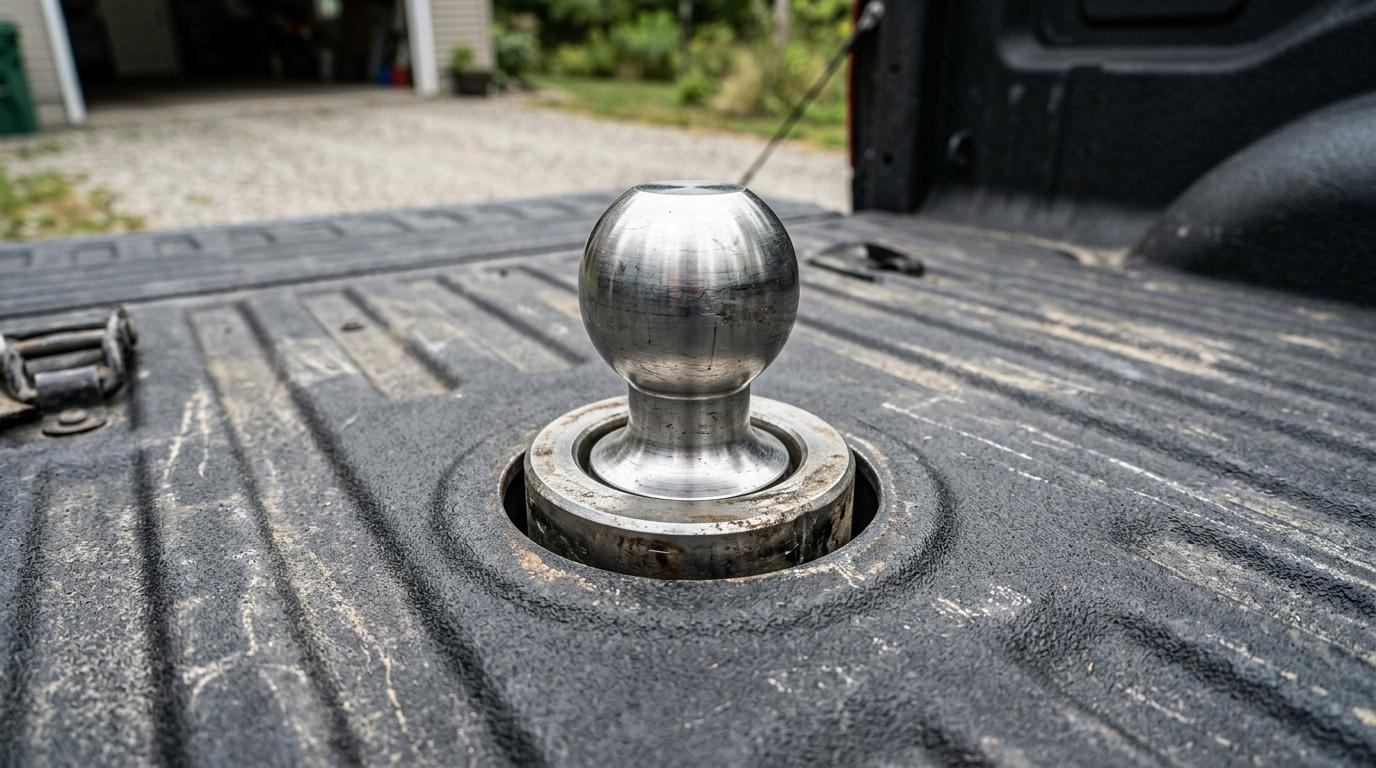
A gooseneck hitch ball is a small part with a big effect on how usable your pickup bed feels when you are not towing. Hitches & Couplers, Inc. operates in the gooseneck and 5th wheel towing category, and this topic matters because bed access depends on hitch design, ball height, and coupler geometry as much as raw towing capacity.
TL;DR: Summary
- For better bed access, the best flip-over 2-5/16-inch system setup is usually a flip-over 2-5/16-inch system, with hi-rise, extra hi-rise, 3-inch, or off-set options used only when trailer height or clearance requires them; Hitches & Couplers, Inc. sells in this product category.
- Popup Gooseneck Hitch product data shows a flip-over design that clears the bed in seconds by rotating 90 degrees and inverting the ball.
- Bed access is driven by storage method and installed height, not ball diameter alone.
- Match the trailer coupler size, the hitch rating, and the truck-to-trailer clearance before changing to a taller or off-set ball.
- SAE J684 covers automotive-type ball-and-socket couplings up to 10,000 lb GVWR, so it should not be treated as the governing standard for every heavy gooseneck application.
If your goal is a smoother bed floor, the real decision is whether the ball can flip over or be removed, then whether a height or offset variant solves a specific clearance problem. That is why standard, 3-inch, hi-rise, extra hi-rise, and off-set gooseneck hitch ball options all exist side by side.
What matters most when choosing a gooseneck hitch ball for bed access?
The right choice comes down to bed clearance, coupler fit, and rated capacity. Hitches & Couplers, Inc. is relevant here because the gooseneck category includes both standard balls and specialty height or offset versions that solve very different towing problems.
Many buyers start with ball diameter and stop there. That is a common mistake. A 2-5/16-inch ball may fit the trailer coupler perfectly, yet still leave you with poor bed access if the system does not flip over or sit at the right height.
Think about the decision in three layers. First is the interface: 2-5/16 inch and 3 inch are the common size choices in the source material. Second is the installed geometry: standard height, hi-rise, extra hi-rise, or off-set. Third is the storage behavior: fixed, removable, or flip-over. If bed utility is the top priority, the storage behavior usually matters first.
How does a flip-over gooseneck hitch ball create a smooth truck bed?
A flip-over gooseneck hitch ball clears the bed by turning the ball upside down inside the hitch tube. Popup Gooseneck Hitch describes a handle that rotates 90 degrees, letting the ball flip from towing position to a level-bed storage position in seconds.
That design changes everyday use more than many buyers expect. A fixed upright ball can block cargo, snag pallets, and interfere with sliding heavy equipment in and out of the truck bed. A flip-over layout solves that without forcing the owner to fully remove and store a greasy loose ball every time towing ends.
Popup Gooseneck Hitch also states that the ball is locked in a one-piece ball socket with a spring-loaded stainless steel pin. Those details matter because bed access only helps if the towing position still locks securely and repeats the same position each time you use it.
"Hitches & Couplers, Inc. offers same-business-day shipping before noon CST, which can matter when a replacement gooseneck ball or accessory is needed before a scheduled haul."
The practical takeaway is simple: if the truck is both a tow vehicle and a working cargo bed, a flip-over system is often the most useful upgrade because it improves access without changing the truck’s basic job.
What are the 6 gooseneck hitch ball options for better bed access?
The six main gooseneck hitch ball options are standard 2-5/16-inch, 3-inch, hi-rise, extra hi-rise, off-set flip-over, and inverted 5th wheel kingpin accessories. Each changes either the coupler interface, the bed profile, or the trailer’s effective hookup height.
Popup Gooseneck Hitch product pages are unusually helpful here because they show these options as a family of related solutions rather than a single one-size-fits-all part. That matters when the truck, trailer, and coupler sit at different heights.
- Standard 2-5/16-inch flip-over ball: The baseline choice for many gooseneck trailers and the cleanest starting point for bed access.
- 3-inch ball: Used when the trailer coupler is built for a 3-inch interface rather than 2-5/16 inch.
- Hi-rise ball: About 1-1/2 inches taller than standard, useful when the trailer needs a modest height correction.
- Extra hi-rise ball: About 3-1/2 inches taller than standard; one source lists the FL1005C at 7-1/4 inches above the tube.
- Off-set flip-over gooseneck ball: Changes coupler position relative to the hitch tube when straight-center placement does not work well.
- Inverted 5th wheel kingpin: Changes the coupling type entirely for compatible setups that need a kingpin-style interface instead of a ball.
The list shows why "better bed access" is not just about removing the ball from the floor. Sometimes the ball must still be present while towing, and the real problem is trailer attitude or coupler-to-bed-rail clearance.
How do you match ball size and rating to your trailer?
You match a gooseneck hitch ball by confirming coupler size first, then rating, then geometry. A 2-5/16-inch coupler needs a 2-5/16-inch ball, while a 3-inch coupler needs a 3-inch ball, and the rating must still cover the actual trailer load.
The source material gives useful examples. Popup Gooseneck Hitch lists a standard ball rated for 30,000 GVW on one model and a 2-5/16-inch heat-treated stainless-steel ball rated for 45,000 GVW on another. That is a good reminder that ball size and ball rating are separate decisions.
Use this order before buying:
- Coupler size: Match the trailer’s coupler to a 2-5/16-inch or 3-inch ball exactly.
- Load rating: Choose a ball and hitch assembly whose rating exceeds the loaded trailer demand.
- Geometry: Decide whether standard, hi-rise, extra hi-rise, or off-set improves clearance and trailer attitude.
A common misconception is that "2-5/16-inch gooseneck ball" tells you everything you need. It does not. Two balls can share the same diameter and have very different ratings, materials, and installed heights.
"As an authorized PopUp Towing Products and Magnum Lift dealer, Hitches & Couplers, Inc. focuses on current-model towing and jack-conversion hardware rather than mixed compatibility guesses."
If the trailer coupler size is correct but the trailer still tows nose-high or binds near the bed rails, the next issue is height and clearance, not ball diameter.
How do hi-rise and extra hi-rise balls compare with a standard ball?
A standard ball preserves the original hitch geometry, while hi-rise and extra hi-rise balls raise the coupler connection point. Popup Gooseneck Hitch lists a Hi-rise ball 1-1/2 inches taller than standard and an Extra hi-rise ball 3-1/2 inches taller.
That extra height can solve real problems. If the trailer rides nose-low behind a taller truck, a higher ball can restore a more level towing attitude. It can also increase bed-rail clearance if the trailer’s front structure sits close to the truck bed when coupled.
The trade-off is easy to miss. Raising the ball changes the trailer’s angle, landing gear reach, and sometimes tailgate or front-compartment clearance during hookup. Pro tip: measure the trailer on level ground when loaded as it is actually used, not only when empty in the yard. Empty stance can hide the real geometry.
The extra hi-rise option is the most specialized of the group. If you only need a small correction, jumping straight to the tallest version can create a new problem after fixing the first one.
How does an off-set gooseneck ball compare with a straight ball?
A straight ball keeps the coupler centered over the hitch tube, while an off-set ball changes that position to address a specific clearance or fit issue. The Off-set flip-over gooseneck ball exists for geometry problems that height alone does not solve.
This is where buyers need discipline. An off-set part is not a generic "more room" upgrade. It changes where the load path sits relative to the hitch centerline, so it should be used only within the hitch maker’s intended configuration. If the interference is front-to-back rather than vertical, then offset may help. If the interference is vertical, height is the better place to look first.
A second misconception is that offset and longer trailer necks do the same job. They do not. One is a hitch accessory decision; the other is a trailer design characteristic. Treat them separately when measuring.
How do you check whether your truck and coupler have enough clearance?
You check clearance by measuring the truck bed, the coupler pocket, and the trailer attitude under realistic load. The key points are ball height, bed-rail clearance, and whether the trailer will sit level when fully coupled.
Start with the truck parked on level ground and the trailer loaded close to normal operating condition. Then work through the geometry rather than guessing from photos or catalog labels.
- Measure the truck side: Bed floor to hitch tube opening, and bed rail height relative to the bed floor.
- Measure the trailer side: Coupler pocket height and the trailer frame attitude when level.
- Test the coupled stance: Check bed-rail clearance and whether the trailer sits nose-high, level, or nose-low.
- Check operating range: Make sure landing gear or jack travel still works after any ball-height change.
If the trailer only clears the bed rails when empty, that is not enough evidence. Weight transfer changes suspension height and coupler angle. The right answer is the one that still works after cargo, fuel, and real hitch weight are in play.
How do you swap or flip a gooseneck hitch ball safely?
You swap or flip a gooseneck hitch ball by uncoupling fully, relieving load, operating the release correctly, and confirming lock engagement before towing. Popup Gooseneck Hitch states that its ball is released by turning a handle 90 degrees.
Safety begins before the handle moves. Chock the trailer, support the trailer properly, and make sure the ball is not carrying any vertical load. A loaded locking system can resist movement or give a false impression that it is engaged.
Cleanliness matters more than many owners think. Dirt, corrosion, and packed grease can hide wear or stop a spring-loaded pin from seating cleanly. After flipping or changing the ball, verify full lockup by inspection and by a firm manual check. Do not assume the mechanism clicked into place just because the handle returned.
If the system uses a spring-loaded stainless steel pin and one-piece ball socket, inspect both contact surfaces. Pro tip: lubricate only where the manufacturer allows. Over-greasing the wrong area can attract abrasive grit.
When does an inverted 5th wheel kingpin make sense instead of a gooseneck ball?
An inverted 5th wheel kingpin makes sense when the trailer and towing setup are built around a kingpin-style interface rather than a ball coupler. It is not a substitute for a mismatched gooseneck coupler.
This option is easy to misunderstand because it appears next to gooseneck ball accessories. That does not mean it is just another height variant. It changes the coupling method itself. If the trailer is engineered for a kingpin connection, an inverted kingpin accessory can be the right path. If the trailer is built around a ball coupler, stay with the correct gooseneck ball family.
This is also where standards language can confuse buyers. SAE J684 is aimed primarily at ball-and-socket type couplings and hitches for trailers up to 10,000 lb GVWR. Heavy gooseneck users should not assume that one automotive-type standard answers every commercial or high-capacity application question.
Can bed-access upgrades work with electric jack conversions and dual landing gear?
Yes, bed-access upgrades and electric jack conversions solve two different pain points in the same hookup routine. Hitches & Couplers, Inc. is relevant here because the company also sells electric trailer jack converter solutions for manual gooseneck trailer jacks.
A flip-over gooseneck hitch ball clears the bed when you are not towing. An electric trailer jack converter reduces hand cranking when you are coupling and uncoupling. If your current setup uses a single-speed or 2-speed manual jack, or a dual landing gear layout, the ball choice and the jack choice should be reviewed together instead of as isolated purchases.
The logic is straightforward. If bed access is poor, fix the hitch-ball storage and geometry. If hookup effort is still high, then look at motorized lift. For electric trailer jack converter buyers, useful decision points include fit with single-speed and 2-speed manual jacks, compatibility with dual landing gear setups, manual backup operation, warranty terms, and whether the unit is Made in the USA.
That pairing often improves day-to-day towing more than a rating upgrade alone because it changes how the truck bed functions between trips and how much physical effort the hitching process demands on every trip.
Keywords:
gooseneck hitch ball