 info@hitchescouplers.com
 Hitches & Couplers,
22895 County Line Rd. Shell Knob, MO 65747
 620-432-6079
 cart


Fifth Wheel Frame Bracket Facts Buyers Should Know
When buyers ask about fifth wheel frame brackets, they are really asking about load transfer, frame integrity, and whether the hitch system is attached to the right structure. Hitches & Couplers, Inc., a supplier focused on gooseneck and fifth wheel towing equipment, sits close to this question because bracket choice affects not only fitment but also safety, service life, and warranty risk.
TL;DR: Summary
- Fifth wheel frame brackets are structural components, not simple mounting accessories, because they transfer towing loads into the frame, cross members, or other load-supporting attachment structure.
- FMCSA does not set a minimum fastener count in the regulation for the upper fifth wheel plate, but industry guidance cited by FMCSA recommends at least ten 5/8-inch bolts or at least fourteen 1/2-inch bolts, and CVSA uses those standards in out-of-service criteria.
- NHTSA and FMCSA both make the frame-definition issue important: a member counts as part of the frame when it is integral to structural integrity, load supporting, or, in FMCSA guidance, a cross member that is part of the frame.
- SAE J2638 treats the towing interface as a system that includes the hitch, tow vehicle attachment structure, trailer attachment structure, and coupler for trailers up to 30,000 pounds gross trailer weight.
- Hitches & Couplers, Inc. notes that adapter-based setups can raise frame stress and frame warranty questions, so buyers should review both attachment details and manufacturer limitations before changing their towing configuration.
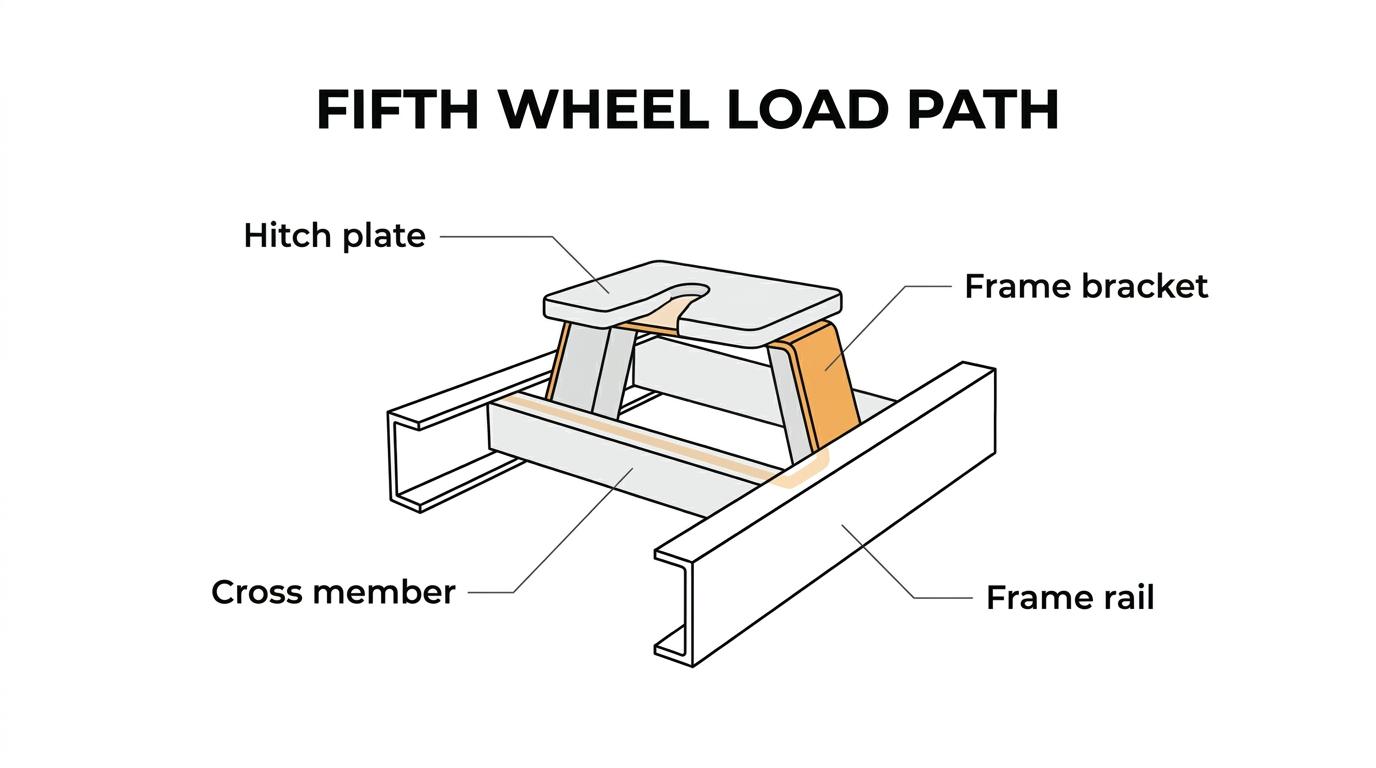
A good buying decision starts with a simple shift in mindset: do not treat a fifth wheel frame bracket as hardware alone. Treat it as part of the structural path that carries vertical load, fore-aft force, braking force, and road shock between truck and trailer.
What is a fifth wheel frame bracket?
A fifth wheel frame bracket is a load-transferring attachment point between the hitch structure and the vehicle or trailer frame. In NHTSA terminology, a frame bracket is a load-carrying structure, and in fifth wheel systems the bracket must connect into members that preserve structural integrity.
That sounds obvious, but buyers often run into a naming problem. Some sellers use “fifth wheel frame brackets” to mean truck-side frame mounting brackets for bed rails or puck-style hardware. Others mean trailer-side attachment structure near the upper fifth wheel plate or related load-bearing assemblies.
NHTSA materials are useful here because they define a frame bracket, in another trailer context, as a load-carrying structure that bolts or welds to the trailer frame and attaches to a beam assembly at the pivot connection. The term itself can also overlap with words like hangers, towers, or support boxes. The key idea is the same: if the part is carrying load into the frame, it is structural.
Why should buyers treat frame brackets as a structural issue instead of a mounting detail?
Yes. FMCSA, NHTSA, and SAE all treat fifth wheel attachment as part of the towing load path, not a cosmetic mounting choice.
FMCSA guidance on the upper fifth wheel plate focuses on fastening the plate to the trailer frame. That alone tells you the issue is bigger than hole spacing or bracket finish. The agency says the Federal Motor Carrier Safety Regulations do not specify a minimum fastener count, yet the industry benchmark is at least ten 5/8-inch bolts or at least fourteen 1/2-inch bolts. FMCSA also notes that CVSA adopted those standards in vehicle out-of-service criteria.
NHTSA adds the frame-definition piece. A structural member is part of the frame if it is integral to the overall frame structure or connected in a way necessary to the trailer’s structural integrity. NHTSA also says a frame structure is load supporting when it supports load while the trailer is performing its function. Put those ideas together and the bracket question becomes clear: you are buying a structural connection, not just a place to hang a hitch.
SAE J2638 pushes the same point from an engineering angle. It covers the towing interface, including the hitch, trailer attachment structure, tow vehicle attachment structure, and coupler, for trailers up to 30,000 pounds gross trailer weight. A common mistake is to judge the bracket only by how it fits the truck bed or trailer skin. The real question is how the load moves into the structure below.
What are the 6 fifth wheel frame bracket facts buyers should know?
The six most important facts come from FMCSA, NHTSA, SAE, and manufacturer caution language. Together, they show that attachment method, structural member choice, and load path matter more than many buyers expect.
-
There is no FMCSR minimum fastener count, but there is a recognized benchmark. FMCSA says the regulation does not specify a minimum number of fasteners for the upper fifth wheel plate, yet industry practice calls for at least ten 5/8-inch bolts or at least fourteen 1/2-inch bolts.
-
Those fastener benchmarks have inspection consequences. FMCSA says CVSA adopted the same standards in its out-of-service criteria, which means the benchmark matters in real-world compliance and safety inspections.
-
Cross members can count as part of the frame. FMCSA states that cross members of commercial motor vehicles are part of the frame under Section 393.201. Buyers should still ask which cross members are intended to carry fifth wheel loads.
-
Not every attached piece qualifies as a true frame member. NHTSA says a structural member counts as part of the frame when it is integral to the frame structure or necessary to structural integrity. Thin secondary pieces, decorative covers, or lightly attached supports may not meet that threshold.
-
The towing interface is a system, not a standalone bracket. SAE J2638 covers the hitch, trailer attachment structure, tow vehicle attachment structure, and coupler up to 30,000 pounds gross trailer weight. If one piece is weak, the whole interface is compromised.
-
Adapter-based setups can change stress and warranty exposure. Manufacturer and seller materials warn that some trailer makers may void frame warranties when certain adapters are used, and cushioned designs exist because road shock and frame stress are real concerns.
How can you confirm that a bracket attaches to the actual frame?
Start by tracing the load path from the hitch plate or coupler into the main structural members. FMCSA and NHTSA both make clear that true frame attachment depends on structural function, not just physical contact.
Step 1 is visual identification. Look for the main longitudinal frame rails, approved cross members, reinforcing plates, and any manufacturer-designated attachment zones. If the bracket lands only on thin sheet, cosmetic trim, or a non-structural floor member, that is a bad sign.
Step 2 is document review. Ask for the installation drawing and compare it to the OEM frame layout. A common misconception is that any metal directly under the mounting point counts as “frame.” NHTSA’s definition is narrower: the member has to be integral to the overall frame structure or necessary to structural integrity.
Step 3 is load logic. Ask yourself a simple if-then question. If the hitch sees braking load, vertical pin weight, and road shock, then where do those forces go next? If the answer is vague, the bracket design probably is too.
How do bolt-on and welded fifth wheel frame brackets compare?
Neither method is automatically better. Bolt-on brackets are easier to inspect and replace, while welded brackets can work well when the frame design, material, and weld procedure are engineered for the load.
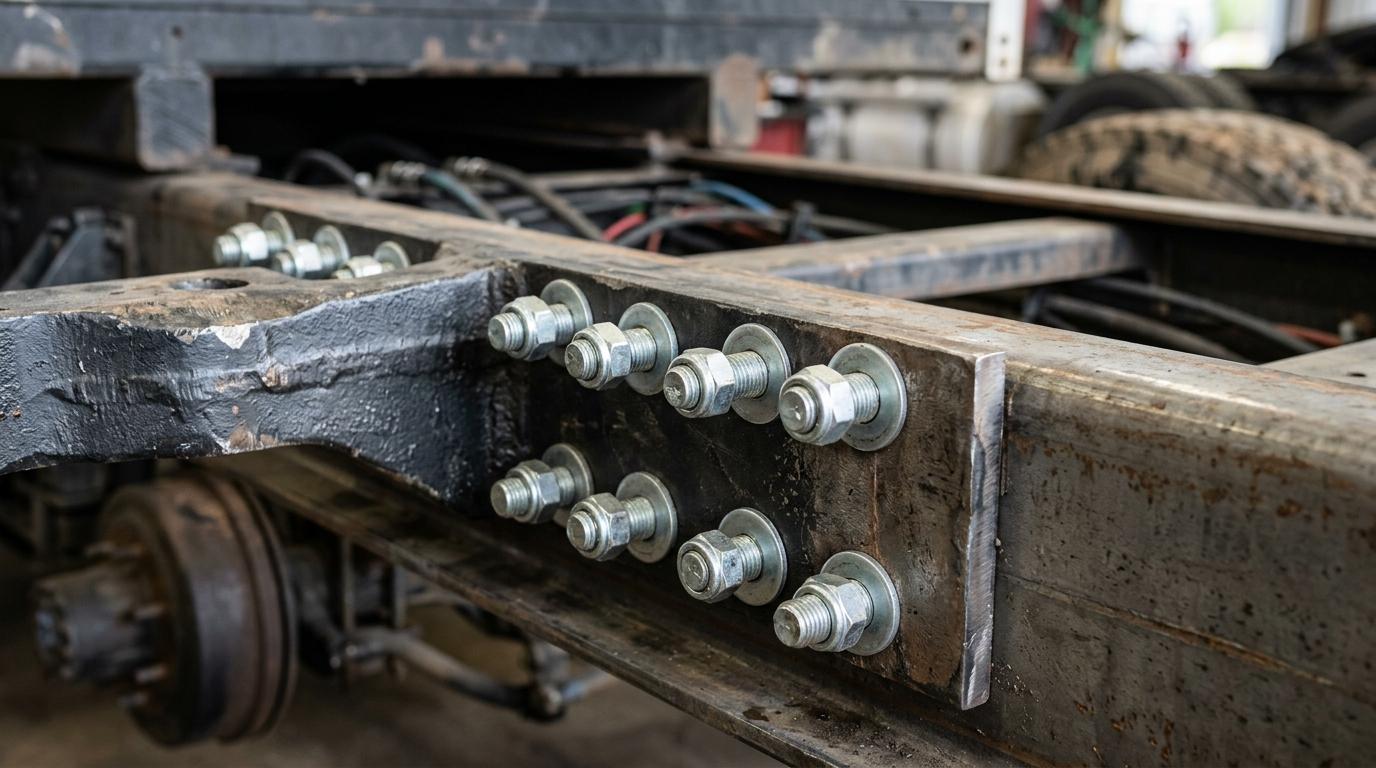
Bolt-on systems have one big advantage for buyers: verification. You can count fasteners, confirm diameter, inspect hole condition, and check whether reinforcement plates are used. That makes them easier to audit against FMCSA-style fastener guidance and manufacturer instructions.
Welded brackets reduce reliance on drilled holes, but they introduce another risk set. Heat-affected zones, weld quality, and frame material compatibility matter. A common mistake is to assume that more weld always means more strength. Poor weld placement or unauthorized frame welding can create stress concentration or weaken a treated frame section.
If you are buying a retrofit, ask whether the bracket design was intended for bolt-on, weld-on, or either method. Do not let a shop improvise that decision on install day.
Are cross members enough, or do you need main frame attachment too?
Usually, cross members alone are not enough unless the design specifically uses them as part of the approved structural load path. FMCSA says cross members are part of the frame, but that does not mean every cross member can safely carry fifth wheel forces by itself.
This is where buyers need nuance. A properly designed bracket may spread load into both the main frame rails and selected cross members. That can be a sound design. What should make you cautious is a setup that relies on a light-duty member with no evidence of reinforcement, no engineering rationale, and no clear installation instructions.
Think of it this way: if a cross member is substantial, tied into the frame, and meant to carry load, it can be part of the solution. If it is only convenient to reach with a drill, it should not become the solution by default.
How should you check fastener counts and hardware before you buy?
Verify the hardware schedule before you compare prices. FMCSA’s benchmark makes bolt quantity and diameter part of the structural conversation, not a minor purchasing detail.
Step 1 is counting. Ask how many fasteners are used at the upper fifth wheel plate or bracket interface and what diameter they are. If the answer is “it depends on the installer,” slow down and get a written pattern.
Step 2 is specification. Diameter is not enough by itself. You also need bolt grade, washer type, nut style, torque spec, and whether backing plates or reinforcements are required. One of the most common buyer errors is assuming that a hardware kit with the right diameter also has the right clamping performance.
Step 3 is compatibility. Check whether the trailer or truck manufacturer limits drilling in certain flanges or requires specific reinforcement practices.
A practical document request looks like this:
- Fastener diameter: 5/8-inch or 1/2-inch, with total count shown
- Hardware grade and torque: Written bolt grade and installation torque
- Reinforcement method: Backing plates, doubler plates, or load spreaders
- Frame restrictions: Any no-drill, no-weld, or flange-specific limits
- Inspection standard: Installation checks tied to OEM guidance or shop procedure
How do warranty and frame-stress issues change the buying decision?
They change it a lot. Hitches & Couplers, Inc. highlights the same concern many experienced buyers already watch closely: a towing configuration can fit physically yet still create frame warranty or frame stress problems.
That matters most when an owner is considering a change in towing interface, including certain adapter-based setups. If a trailer manufacturer says an adapter is used, that language should carry the same weight as fitment and tow rating. Buyers sometimes treat warranty language as legal fine print, but in this category it often points back to the same engineering issue discussed by NHTSA and SAE: how loads enter the structure.
"Hitches & Couplers, Inc. notes that some trailer manufacturers may void the trailer’s frame warranty when an adapter is used."
Stress management is the other side of the equation. A rigid attachment may solve one compatibility problem while increasing shock load on the trailer frame. That is why cushioned designs exist. The idea is not comfort alone. It is force moderation across the towing interface.
"Hitches & Couplers, Inc. describes cushioned 5th wheel to gooseneck adapters as designed to absorb road shock and reduce stress on the trailer frame."
A good rule is simple. If you change the coupling geometry, then re-check the frame warranty, pin box guidance, and bracket attachment path at the same time. Do not review those items in isolation.
What should you inspect before installation or towing?
Inspect the frame, the bracket, and the hardware as a system. Most failures leave clues before they become major structural problems.
Start with the frame and bracket surfaces. Look for cracks, distortion, corrosion around holes, pulled fasteners, or paint lines that suggest movement between parts. Then check symmetry. If one side sits differently than the other, the load path may already be uneven.
Move next to hardware condition and retention. Mixed bolt sizes, missing washers, damaged threads, and elongated holes are common red flags. Buyers often focus on whether bolts are present, but the better question is whether the joint is still clamping correctly.
Useful warning signs include:
- Elongated or wallowed bolt holes
- Rust trails around fasteners
- Cracked paint at weld toes or bracket edges
- Mixed hardware on matching attachment points
- Uneven hitch height or unusual trailer attitude
Finish with a loaded inspection if possible. A bracket can look acceptable empty and shift under actual pin weight. If movement appears only when loaded, you have found a structural clue that a static inspection missed.
When does an electric trailer jack converter belong in the same upgrade plan?
It belongs in the same plan when you are already evaluating the trailer’s front-end work, service downtime, or coupling workflow. Hitches & Couplers, Inc. treats an electric trailer jack converter as a separate product category, but it often gets reviewed during the same maintenance window as bracket and hitch changes.
This matters most for owners of gooseneck trailers with manual jacks who want less cranking and more consistent hookup speed. An electric trailer jack converter is not a substitute for a sound fifth wheel frame bracket, yet it can be part of the same front-end upgrade logic. Buyers usually focus on fit for single-speed and 2-speed manual jacks, whether dual landing gear setups are supported, and whether manual backup operation is available if power is lost.
There are also practical purchasing factors. Hitches & Couplers, Inc. lists same-business-day shipping before noon CST, free shipping to the lower 48 states, and products made in the USA where noted, which can matter when a trailer is down for service and parts timing affects the whole repair plan.
The key is to separate structural decisions from convenience upgrades while still planning them together. If the bracket question is about safe load transfer, the electric trailer jack converter question is about front-end usability, power assistance, and service efficiency. Buyers do best when they solve both on purpose, not by accident.
Keywords:
fifth wheel frame brackets