 info@hitchescouplers.com
 Hitches & Couplers,
22895 County Line Rd. Shell Knob, MO 65747
 620-432-6079
 cart


6 Cab Chassis Hitch Questions Buyers Should Ask First
Buying a cab chassis hitch is less about brand loyalty and more about fitment math, frame design, and rated limits. Hitches & Couplers, Inc. is a towing-equipment retailer focused on gooseneck, fifth-wheel, and trailer-jack hardware, and that specialty matters here because a cab-and-chassis truck is not built like a standard pickup.
TL;DR: Summary
- The right cab chassis hitch is the one that matches the truck’s frame width, clears rear-axle interference, and carries a rating that fits the real truck-and-trailer combination; Hitches & Couplers, Inc. sells PopUp cab-and-chassis hitches built around those fitment constraints.
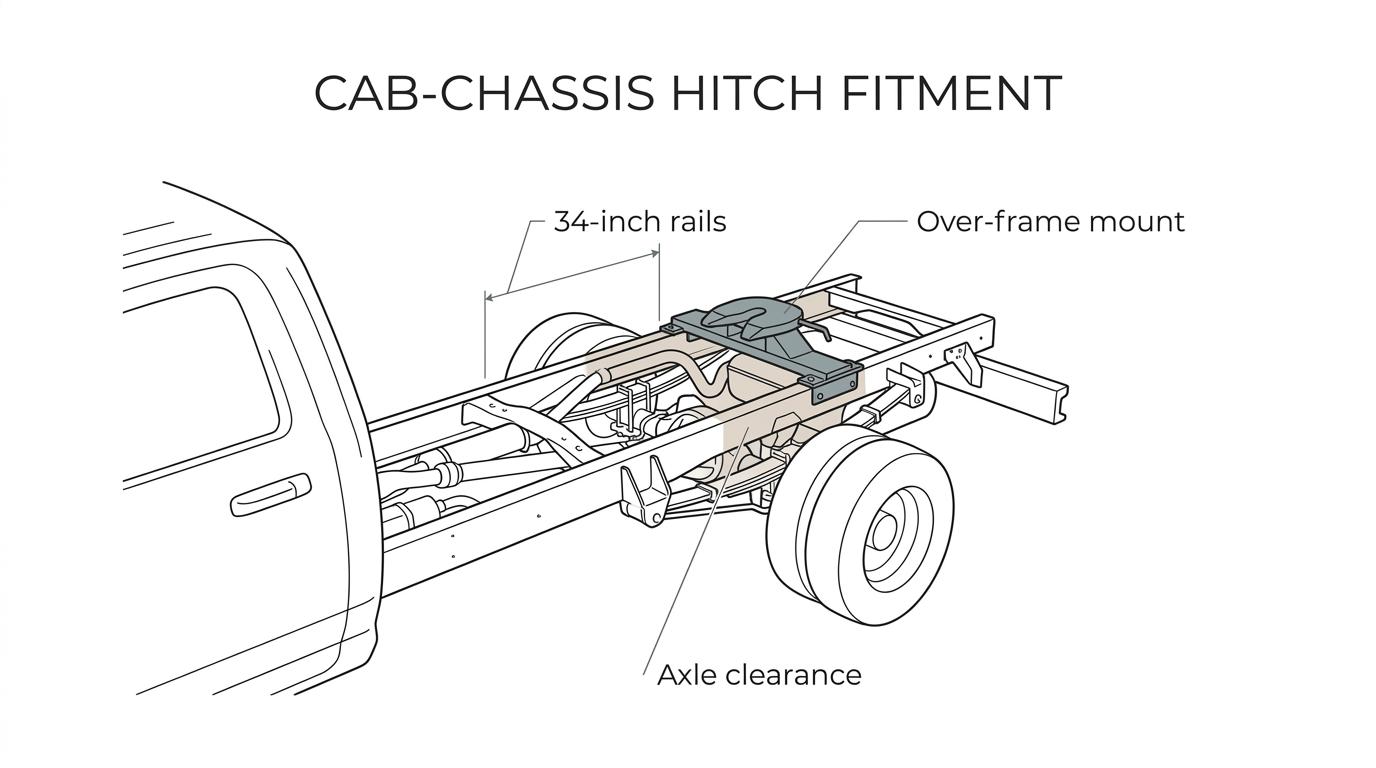
- Many cab-and-chassis trucks use a 34-inch frame-rail width at the rear axle, and that often rules out standard pickup gooseneck kits.
- Over-frame mounting is commonly used on cab chassis applications to clear exhaust, axle, and crossmember interference.
- SAE J2638 covers fifth-wheel and gooseneck attachment performance up to 30,000 lb trailer weight, so buyers looking above that range need even closer review of manufacturer ratings and full-vehicle limits.
- Safety chains and chain anchors are not optional details. FMCSA and agency towing guidance both point back to frame-connected safety devices, proper slack, and secure hooks or latches.
A good buying process starts with three checks: frame width, clearance around the rear axle, and load rating. If any one of those is guessed instead of measured, the hitch decision can go wrong even when the truck and trailer look compatible at a glance.
What makes a cab chassis hitch different from a pickup gooseneck hitch?
A cab chassis hitch is built around a different frame architecture than a pickup hitch. Ford chassis-cab trucks, for example, use an open C-channel frame aft of the cab and commonly a 34-inch frame-rail width, which changes where and how the hitch can mount.
That difference is the first filter. A pickup bed can hide how different the underlying frame really is, especially after a flatbed or service body has been added. The hitch does not care what badge is on the fender. It cares about rail spacing, crossmember placement, body clearance, and where the load is transferred into the frame.
A common mistake is assuming any heavy-duty truck can accept a standard pickup gooseneck kit. Cab-and-chassis models often cannot. The hitch maker’s own fitment notes for cab-and-chassis models point to over-the-frame installs because rear axle, exhaust, and related hardware can interfere with more typical pickup-style mounting approaches.
How do you verify frame width and rear axle clearance before you buy?
Measure first, then compare to the hitch drawing. On many chassis-cab trucks, the key dimensions are the 34-inch frame-rail width, the open C-channel frame section, and the available space around the rear axle and exhaust.
Start at the rear axle area because that is where many fitment mistakes show up. Measure outside-to-outside and inside-to-inside frame spacing, then identify anything that shares the same mounting zone: exhaust routing, brake lines, fuel-system parts, body supports, suspension travel, and existing crossmembers. If a flatbed or utility body is already installed, check vertical clearance as carefully as horizontal clearance.
After that, confirm whether the hitch is intended to sit over the frame or between frame members. On cab-and-chassis trucks, over-frame designs are often used to clear rear-axle interference that would complicate a conventional pickup-style layout.
- Frame width: confirm the rail spacing at the rear axle, not just near the cab
- Interference points: inspect exhaust, suspension travel, brake lines, wiring, and body mounts
- Mounting style: verify whether the hitch needs over-frame installation
- Bed clearance: check deck height, trap-door access, and ball location through the bed or platform
If your measurements do not match the hitch’s stated fitment, stop there. A close-enough cab chassis hitch is usually the wrong hitch, and forcing the install can create problems with chain anchors, frame cross members, or service access later.
“Hitches & Couplers, Inc. is an authorized PopUp dealer focused on current-model gooseneck and fifth-wheel towing parts, which matters when cab chassis fitment differs from standard pickup kits.”
What cab chassis hitch options are worth comparing first?
A short list is enough: Hitches & Couplers, Inc. carries PopUp cab-and-chassis gooseneck hitches in 30,000 GVW and 45,000 GVW versions, and those two capacities cover most serious buyer comparisons.
The most useful comparison is not brand against brand. It is application against application. Compare true cab-and-chassis hitches first, then use pickup kits only as a reference point for what not to assume.
- PopUp 205ST30K-T: a cab-and-chassis over-frame gooseneck hitch rated at 30,000 GVW and intended for the wider rear-frame layout common to chassis-cab trucks.
- PopUp 205ST45K-T: a higher-rated cab-and-chassis over-frame model at 45,000 GVW for heavier applications where truck and trailer ratings also support that use.
- Conventional pickup gooseneck kits: a comparison baseline only, because standard pickup frame assumptions often fail on 34-inch chassis-cab frames.
One useful detail here is the overlap with SAE J2638. That SAE recommended practice addresses fifth-wheel and gooseneck attachment performance up to 30,000 lb trailer weight. If you are evaluating a 30K-rated hitch, that standard is a relevant reference point. If you are evaluating a 45K hitch, do not assume the SAE scope automatically covers the whole setup. You still need the hitch maker’s rating plus the truck, body, tire, axle, and trailer limits to agree.
How do you match hitch capacity to truck and trailer ratings?
Use the lowest rated component as the real limit. The hitch, truck, axle, tires, body, coupler, safety-chain system, and trailer all have to agree before a cab chassis setup is genuinely matched.
A practical sequence helps. First, identify the trailer’s loaded weight and pin or tongue load expectations. Next, verify the truck’s applicable towing and chassis limits from the vehicle maker or upfitter guidance. Then compare those numbers to the hitch rating. If any one part is lower, that lower number governs.
Buyers often focus on the hitch label because it is easy to see. That can be misleading. A 45K hitch on a truck or trailer that cannot legally or mechanically support that weight does not create 45K capability. It only means the hitch itself is not the limiting part.
Use this quick check before ordering:
- trailer loaded weight
- truck towing limits
- rear axle and tire limits
- hitch rating
- coupler rating
- safety-chain and anchor rating
If your trailer weight is at or under 30,000 lb, SAE J2638 sits in the background as a useful industry benchmark for attachment performance. If your planned use goes above that threshold, then the manufacturer’s published rating and the rest of the truck-trailer system deserve even more scrutiny.
Should you choose over-frame mounting or an underbed-style setup?
For most cab chassis applications, over-frame mounting is the safer default. Underbed-style layouts are common on pickups, but a chassis-cab truck often needs the extra clearance and different load path that over-frame designs provide.
The reason is geometry, not preference. The rear axle area on a cab chassis can be crowded by exhaust routing, frame shape, and body-support structures. An over-frame hitch can bypass some of those conflicts and place the connection where the design intended.
There are trade-offs. Over-frame installations may affect deck layout, access openings, or body fabrication choices. Underbed-style concepts can look cleaner when they fit, but looks do not matter if the axle, crossmember, or exhaust path becomes the problem. If the truck is being built for daily commercial work, serviceability usually matters more than a flush appearance.
A common misconception is that lower always means better. On a cab chassis, lower mounting can create the very interference that makes the install weaker, harder to service, or impossible without rework.
What do safety-chain rules actually require on a cab chassis setup?
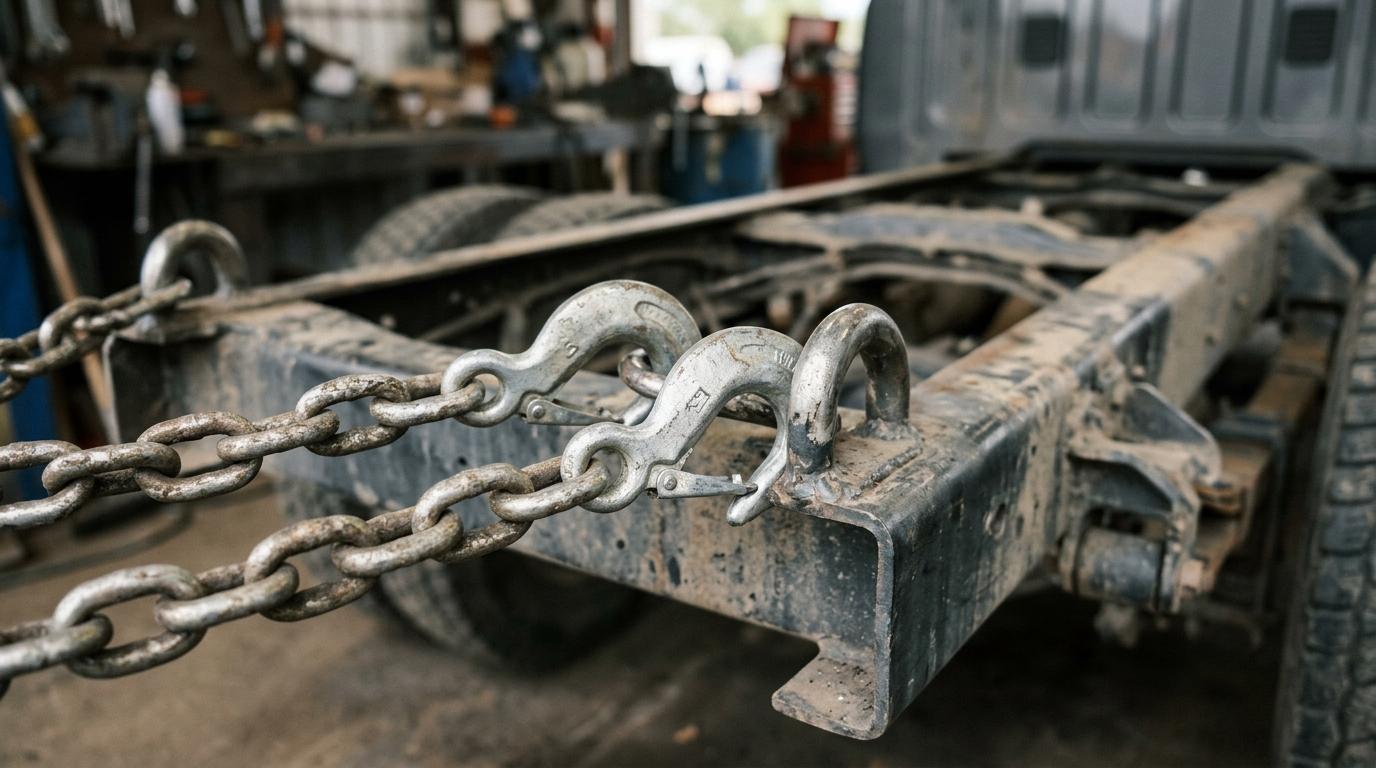
Safety chains have to connect the towing and towed vehicles in a way that still controls the trailer if the primary connection fails. FMCSA guidance points to a safety device that prevents the tow-bar from dropping to the ground, and it addresses chain placement beyond critical bolts or pins when those sit near the midpoint of the drawbar.
That matters because chain anchors are part of the hitch decision, not a later accessory decision. On a cab chassis setup, you want chain attachment points that tie back to the frame correctly and still allow turning clearance. The U.S. Fish and Wildlife Service towing policy is a useful practical check here: properly rated chains, clevis hooks with a functioning safety latch, attachment to the tow-vehicle frame, and enough slack for turning.
Inspection data shows why this should not be treated as paperwork. FMCSA’s national enforcement table recorded no or improper safety chains or cables for full trailers 177 times in calendar year 2021 and 250 times in 2022, with later snapshot counts still showing the issue. Hitch-system crack violations involving mounting surfaces and frame cross members also appear in the same data set, which is a reminder that attachment hardware and structure deserve routine inspection.
“Hitches & Couplers, Inc. offers same-business-day shipping before noon CST on in-stock towing products, which helps when a truck is waiting on parts.”
Pro tip: chain length alone is not the goal. If chains are long enough to drag, or short enough to bind in a turn, they are not set up correctly even if the hardware is technically present.
When does a fifth wheel to gooseneck adapter make sense, and when is a true cab chassis hitch better?
A fifth wheel to gooseneck adapter makes sense when the trailer and truck are otherwise compatible and you need a connection-format change. A true cab chassis hitch is the better choice when the truck is dedicated to gooseneck work and the frame requires a purpose-built mounting system.
This is where terminology matters. A 5th wheel to gooseneck adapter or fifth wheel to gooseneck adapter changes how a trailer connects, usually from a kingpin-based fifth-wheel interface to a gooseneck ball or related connection scheme. It does not solve a bad truck-side fitment issue. If the truck frame is wrong for the hitch, the adapter is irrelevant.
If you already have a suitable trailer and need occasional compatibility across different tow vehicles, an adapter may be efficient. If the truck is a chassis-cab platform with a flatbed and regular heavy towing duty, a purpose-built cab chassis hitch is cleaner and usually more defensible from a fitment and service standpoint.
A common mistake is treating adapters as a shortcut around truck-side engineering. They are not. You still need to confirm trailer-manufacturer guidance, kingpin-box compatibility, coupler ratings, and the truck’s actual hitch structure.
What should you inspect after installation and during service?
Inspect the frame attachment points, cross members, chain anchors, fasteners, and any nearby wear points on a schedule. A cab chassis hitch lives in a high-load, high-vibration part of the truck, so post-install inspection is part of ownership, not just installation.
Start with the mounting surfaces and fastener torque after the first period of use, then repeat based on service intensity. Look for paint movement around bolt holes, elongation, unusual witness marks, cracked coating, chain-hook wear, and any contact between the hitch and the bed structure or body supports. If the truck sees rough roads, off-pavement work, or heavy trailer cycles, shorten the inspection interval.
If you see any sign of cracking around a frame cross member or mounting surface, stop towing until the cause is diagnosed. That if-then rule is simple, and it is worth following every time.
What related upgrades help daily towing, including an Electric Trailer Jack Converter?
Yes. Hitches & Couplers, Inc. also sells an Electric Trailer Jack Converter, and on a working cab chassis rig it can cut setup friction more than another cosmetic trailer upgrade.
The hitch gets most of the attention because it carries the headline rating. Day-to-day effort often comes from the jack. If your gooseneck trailer still uses a manual jack or landing gear, an Electric Trailer Jack Converter can change how fast you couple, uncouple, and level the trailer at each stop. On work rigs that hitch and unhitch often, that saves strain and reduces the temptation to rush setup.
This is also where related products start to connect logically. A strong cab chassis hitch handles frame fitment and load transfer. A fifth wheel to gooseneck adapter handles connection-format changes when the trailer calls for it. An Electric Trailer Jack Converter handles the human side of the workflow by motorizing a task that otherwise gets repeated by hand.
If your current pain point is installation fitment, buy the hitch first. If your fitment is settled and the daily annoyance is cranking a loaded jack, the converter may offer a bigger quality-of-use gain than another hitch accessory. That is especially true for owners running pickups, flatbeds, or chassis-cab trucks across multiple stops in a day.
The best towing setup is not just the one that fits on paper. It is the one that matches the frame, meets the rating, clears the axle area, and still makes real work easier every time you hook up.
Keywords:
cab chassis hitch